Showing posts with label Conferring. Show all posts

Tuesday, December 11, 2018

Tuesday Slice of Life & Haiku-A-Day December Challenge #11 Mash Up: Break the Fake

Looking to connect with a positive, supportive online community?  Consider sharing a slice of your life with Two Writing TeachersAll writers are welcome! 


I am joining Elisabeth from The Dirigible Plum in writing a Haiku-A-Day during the month of December. 

Haiku-A-Day December Challenge #11: Break the Fake 

Each of my high school classes begins with at least ten minutes of daily independent reading. Many of my sophomores are currently reading To Kill A Mockingbird as a requirement for their English Language Arts class. Although I encourage students to read a book that they like and want to read, I allow students to read books assigned from another class. 

Yesterday, in between conferring with students in one of my literacy support class hours, I observed one of my students pretending to read To Kill a Mockingbird

Yup, fake reading. 

It is December and even after all of the book talks, conferring, and sincere conversations about the purpose of reading, fake reading still happens. This used to bother me a lot, but it just reminds me to not give up on my students. 

Read about fake reading in my double Haiku below: 

She giggles. Page turn
in To Kill A Mockingbird.
Book tilt. Pretend read.

Phone concealed inside
novel. Body shifts when I 
walk by...break the fake. 

Tuesday, November 6, 2018

Slice of Life Tuesday: Conferring Win

"Reading is oxygen for a student's future success." 
Penny Kittle from Book Love (Heinemann, 2012) 

I was conferring with one of my high school seniors yesterday. Typically I begin with a question like, how's it going or what's worth talking about? or a comment such as, tell me a bit about what you are reading

When I sat down to confer with *Alma, I wanted to emphasize that I noticed that she had read several books this year and not because she was abandoning book after book. She consistently seemed engaged in what she was reading! 

"Did I see that you just began your fourth book?" I quietly asked Alma as we sat down.

Alma gave me a huge grin as she shared the titles that she has read since school began, including: Living Dead GirlThe Secret Life of Sonia Rodriguez, and Someone Like You.

"Have you always been an avid reader?" I asked.

"What do you mean? Avid?" Alma asked.

"Avid means you read a lot." I responded.

Alma smiled and added, "Haha. Nope. This is the most that I have ever read! Like in my life. I can't remember the last time I read a book. I used to hate reading. Now I read at home. Instead of binge watching on Netflix or scrolling on my phone. My mom even wanted to know what I was reading."

It was my turn to grin. 

"What do you think made the difference?" I inquired.

"I think that I actually care about what I am reading. I think about what I want to read."

"Are you surprised at this difference?"

"Yeah. I didn't know that I liked to read." 

Until we had this conversation, I had no idea how much she used to hate reading. She marked on an interest survey at the beginning of the year that she believed she was a nonreader, but I didn't know to what extent. I couldn't help thinking that until this year, she had probably given up on herself as a reader. Did she feel that her former teachers gave up on her as a reader? 

Now, in the first semester of her senior year, Alma reads at school and at home for the first time in years. Maybe ever. She even cares about the books she reads.

Win!

Win!

Win! 

This conversation boosted my mood all day. It made me feel like providing the time for independent reading, sharing book talks, spending way too much money on my classroom library, and taking the time to confer has made a difference for students like Alma. 

But, if I am really honest, these amazing conferring conversations don't happen every day. Sometimes conferring is really hard. Sometimes I find that conferring conversations are awkward, and I need to remind myself to listen better to my students. It's November and I still have a handful of students in each class who still have not found the right book yet. These are the students who abandon book after book. These are the students who are still fake reading. These are the students that really stretch me as a teacher. 

Part of my professional learning this year is focused on conferring. I am still learning about how to have better, more productive conversations with my students - especially my students who have not seen the value in reading yet. I am revisiting and studying professional books such as Book Love and Conferring: The Cornerstone of Reader's Workshop

I still have a lot to learn. 

*Alma is a pseudonym 

Join the Two Writing Teachers Community and share your Slice of Life today! Everyone is welcome! 

Tuesday, October 9, 2018

Slice of Life Tuesday: Awkward Conferring Moments

"I don't read. I don't do reading. I don't do books." 

A fourteen-year-old student, *Ellen, shared these three strong phrases with me today while I was conferring with her. 

I have been observing Ellen's reading behavior during our daily independent reading time for the last few days. She selected a thick book. She's quiet as we read. She turns pages every few minutes. She even uses a book mark. It looks like she is reading and enjoying it. 

Yet in the first few moments of our conversation, she couldn't tell me what her book was about. At all. She couldn't provide me with any predictions or even a superficial connection. She did not have anything to share that she thought was worthy to talk about.

"How did you select this book?" I asked Ellen.
"It looked cool, " Ellen replied.
"Tell me more about what you are thinking. What made it look cool?" I prompted.
"Um. I liked the cover?" She responded.
"Oh, sometimes looking at the cover is a great way to pick out books. I am often attracted to great covers too. What did you like about the cover?"
"I don't know....oh, I liked the lettering," She said. I nodded.
"Did you read the back to see if it looked like a book you might enjoy?"
She shook her head no.
"Did you page through the book?"
Another head nod of no.
"Hmm...Maybe it isn't a good reading fit for you if you cannot think if anything to talk about." I wondered out loud. 
Ellen nodded.  
"Would you want to take a look at a book about design?" I was thinking of introducing her with a design book like Chip Kidd's Go
"Nah. I'm good. This book is okay." 
"Maybe I could help you find a book that you like to read. What are you interested in?"
Ellen simply stared at me. 

I let a few moments of uncomfortable silence pass between us. 

"Ellen, can you remember a book that you read in the past that you really liked?" I asked.
"Not really."
"Is there a title you remember reading last year or in seventh grade?" I asked.
"No."
"What about from elementary school?"
"I told you. I don't do books."
I tried to hold my heavy sigh inside. 

Finally, I asked if Ellen if she had ever tried reading a graphic novel. She hadn't. Although not all students like reading graphic novels, I have found that many of my most reluctant readers are willing to read a few pages of a graphic novel. I gave a few book talks of two  graphic novels: Raina Telgemeier's Drama and Terri Libenson's Invisible Emmie. Reluctantly, she said that she would try Drama

My conferring session with Ellen ended up lasting nearly ten minutes, almost the entire time that I had to confer with students in class today. By the time I handed her Drama, our reading time was over, and I did not get the chance to confer with anyone else. 

Fellow readers, this was an awkward conferring session.These are the kind of conferring sessions that make me cringe and fill me with anxiety. I want each conferring session to run smoothly and efficiently, but this didn't happen today.

However, I know more about Ellen as a reader than I did yesterday. In addition, I have a better sense of what some next steps may be with Ellen.

Not so long ago (maybe six years ago) I wasn't conferring. I told myself (and colleagues) that I didn't think that older students (middle school and up) really needed it. In reality, I was intimidated. I felt so unprepared as a teacher, and I didn't know how to confer well. However, I have learned that the more I confer with my students, the more comfortable I am with awkward conversations like the one with Ellen today. It makes me strive to become ever better at conferring. 

*A pseudonym 

Join me and post your Slice of Life at Two Writing Teachers! Everyone is welcome!  


Tuesday, June 5, 2018

SOL Tuesday: Growth Through Reflection

Join Two Writing Teachers and share your own Slice of Life post today! 

"A defining condition of being human is that 
we have to understand the meaning of our experience." 

Late last week I met with Mike, one of our building's associate principals, who is also my primary evaluator this year. As a part of our teacher effectiveness system in Wisconsin, I needed to reflect on how I grew as an educator this year. Below are two areas that I highlighted with Mike regarding my professional growth for the 2017-2018 school year:

Retrospective Miscue Analysis (RMA)
One of the most exciting, rewarding things that I worked on this year was learning more about and how to deliver RMA to a small group of high school students. (You can read more about my experience with RMA in this post and this post.) Although I discovered that it was not as easy to show student growth on standardized tests and grades using RMA, my students showed growth in reading through other measures such as the frequency of self-corrections, charting the quality of their miscues, and improvements in retelling. However, what stands out the most to me was the rich conversations that I had with my students while delivering RMA. I gleaned invaluable insights about reading as students explained their perspectives to me. In addition, based on student responses from the Burke Reading Interview (BRI), my students' perceptions of themselves as readers became more positive as the year progressed, and they reported employing more strategies as readers by the end of the year. 
A view into a conversation I had with one of my students immediately following an RMA conversation. 
Learning and delivering RMA also provided me with the opportunity to network with experts in the field, such as Dr. Cathy Compton-Lilly and Dr. Yang Wang, both Language and Literacy Professors from the University of South Carolina. I am incredibly grateful for how they helped guide me in how I could use RMA effectively with my high school learners. They patiently answered my questions, routinely shared professional articles, and assisted me in problem solving how I could effectively measure and report student growth using RMA. 

Overall, I am confident that I am a better teacher of readers because of the work I did with RMA this year. As a result of learning, delivering, and analyzing RMA, I now think in a much deeper way regarding the complexity of reading, especially in considering how readers make meaning. I am eager to continue to use RMA with my students next year. 

Building Positive Relationships 
In addition, a huge take away for me was a reminder of how important relationships are. I realized that building relationships is not a "one and done" first few weeks of school activity, like learning student names, or ice breakers. Intentional positive relationship building (and working on a positive classroom community) must occur all year. Through honest student conversations and reading student reflections, I realized how the lack of positive relationships/community is often what impedes learning in a classroom. (You can read some of my journey from the beginning of the year in this post.) Students were not able to engage in learning until there was trust established between teacher and that student. For this reason, I modeled my own thinking, reading, and writing more than I ever have with students in the past. 
A Heart Map I created with my students last week using the document camera. 
As a part of striving to build more positive student-teacher relationships, I used a lot of conferring with all of my students this year. (You can read a bit about my experience in conferring in this post.) Most of my students were not used to a teacher conferring with them individually, especially in reading and writing. This was rocky with all of my classes at the beginning of the school year, but I am glad that I continued to confer with my students. Eventually, conferring became normal in all of my classes. I discovered that conferring with all of my students gave me unique entry points that helped me get to know my students better as individuals and also as learners.
One of my most valuable tools: a notebook I used for daily conferring
****************************

Blogging is one new way that I have reflected my growth as a teacher and learner this year. In fact, I was thrilled when I realized that I could use some of my writing as a part of my formal evaluation this year - so easy to embed links to show as artifacts. I anticipate that rereading my blog posts will continue to be a gauge for growth.  

Have you taken the time to reflect on the school year yet? How did you grow as a professional? 

Saturday, March 10, 2018

Slice of Life 2018 Day 10: Celebrations of Independent Reading

At the beginning of the 2017-2018 school year I began a new-to-me teaching position in my district instructing high school English Language Arts (ELA) to seniors and teaching At-Risk classes to freshmen and sophomores. Despite being an experienced classroom teacher, I was new to my building and the courses I was instructing. Students didn’t know me. Parents didn’t know me. Many of my colleagues didn’t know me.

It was definitely a bumpy start to this school year.


Throughout this year I have been working on establishing a positive community of reading. Just like at the beginning of the school year, each day of each class begins with ten minutes of independent reading and I try to confer with at least three students each day. I wrote about the beginning of my year in this post.

Current popular senior picks for independent reading
Honestly, my students complained a lot about independent reading at the beginning of the year, especially my seniors. The other senior ELA teachers didn’t require independent reading and did not provide time for it in class. My students often vocalized that it was not fair, even though I continued to share why I believed that it was important for students to read. Every. Single. Day. In fact, I have shared snippets of the reading research with my students from this smart blog post written by Donalyn Miller.


Last month I had a conversation with both of my senior classes about reading in class. I told students that it was a nonnegotiable to read in ELA, but that I would be open to try book clubs or a whole class novel for 3rd and/or 4th quarter. I was interested to hear my students' responses to my inquiry. One of my students announced in front of the class, “well, if you really want me to read, let me pick my own books. I will just pretend to read a novel that is assigned to me.” Another student publicly exclaimed, “I finally like reading again! Don’t take it away.”

Those weren’t the only positive comments that I heard about independent reading from my seniors. Nearly all of my students pleaded with me to continue to set aside time for independent reading. Even the students who were the most vocal and negative about reading at the start of the school year. For both of my classes.


Shortly after this conversation, I asked my senior students to anonymously submit answers to this question below on a Google form:

Based on the time you have spent reading your independent book this year, what have you noticed about yourself as a reader?


Below are a few of my students’ responses that I snipped directly from the Google Form.


Now my students seldom complain about independent reading anymore, even those who were the most reluctant (and vocal) at the beginning of the school year.

There are many things that I can continue to do to promote and sustain a positive culture of reading in my room, but for now I am celebrating that many of my seniors now report that they enjoy independent reading and that they are noticing their reading behaviors! WIN!

Saturday, November 18, 2017

Book Love and Conferring

This past summer I joined Book Love Summer Book Love 2017. I listened to phenomenal podcasts produced by Teacher Learning Sessions, read some amazing books (The Crossover, A Prayer for Owen Meany, Revolution, and Disrupting Thinking), and participated in several online discussions through posts in the Book Love Summer Book Club Facebook group. Although I was already a huge proponent of promoting and implementing best practices in literacy, Summer Book Love 2017 helped me think even more deeply about literacy and book access and how I wanted independent reading to be a key component in my high school classroom.


At the beginning of the 2017-2018 school year I implemented a small chunk of independent reading in all of my high school classes as part of the daily routine. At first, my high school seniors especially protested at the scheduled ten to fifteen minutes of daily reading, reminding me that they haven’t been required to read in school every day since middle school (some of them since elementary school). However, I continued to promote the importance of reading, citing studies of the benefits of reading. In addition, I frequently talked about my love of reading and shared quick book talks with my students. In addition, I made time to take students to our school library for book talks and opportunities to check out books. Although it has taken some time to create buy-in with many of my students, I am so glad that I carved out this daily time for reading.  After nearly three months of independent reading, 75% of my students reported in an anonymous Google form I set up that they enjoy this time set aside to read. In fact, one of my students commented that she could not believe that she has read four books already, and she didn’t think that she has read an entire book since eighth grade. Win!


Of course, I have some reluctant readers. You know these students, the ones who are “fake reading” or report that, “reading is just not for me.” I have seen students hide their cell phones in their books (and text or Snapchat while we are reading). I have observed students go through book after book because they cannot find the book that holds their attention yet. Even so, I am still working diligently to find a good match for each student to read. "I'm not giving up on you as a reader" has been my mantra all year.

One of the unexpected benefits from the Book Love Summer Book Club Facebook group is that although the Summer Book Club is over, the online community is still active. I recently posted this question:
I have a student (9th grade girl) who tells me that she hates reading. She said that she doesn't read. I have introduced her to Crank, John Green books, and a few other edgy books (that other students usually like), but she's still a mystery to me. Outside of school she tells me that she likes to sleep and hang out with friends. She isn't a very strong reader. What books would you recommend for me to introduce to her?"
The online community almost immediately flooded me with great suggestions for my student, including graphic novels. I have graphic novels in my classroom library, but I hadn’t introduced them to her yet. The next afternoon I showed her Ghosts by Raina Telgemeier. To my surprise, she devoured Ghosts in a week and then began Smile by the same author. She’s almost finished Smile.

Last week I realized that two of my high school seniors were reading The Giver and they were in different classes. I asked one of the boys what drew him to this title. He responded that he always wanted to read this book and he and his friend were texting each other one night, trying to figure out what to read next. Apparently, they both decided to read The Giver together so they could talk about it. I was elated to discover that they were talking about books outside of class.


Perhaps one of my favorite parts of independent reading this year is conferring. For the longest time (and especially early in my career), I was terrified of conferring. Maybe it was the fear that I wouldn’t do it correctly or that the class would get off task while I was conferring with one student. To be honest, in the past I have been spotty with conferring, giving up when I was feeling defeated because I wasn’t reaching enough students. Then I listened to Penny Kittle speak in her Book Love Podcasts and other teachers rave about conferring. I reread Book Love and realized that one area I could work on this year was conferring. I also remembered some advice that I heard from Donalyn Miller at a conference a few years ago about conferring: every day, as many students as you can, under whatever conditions (her Golden Gate Bridge Method). I actually have this written on the cover of my teaching planner, so I remember it often.
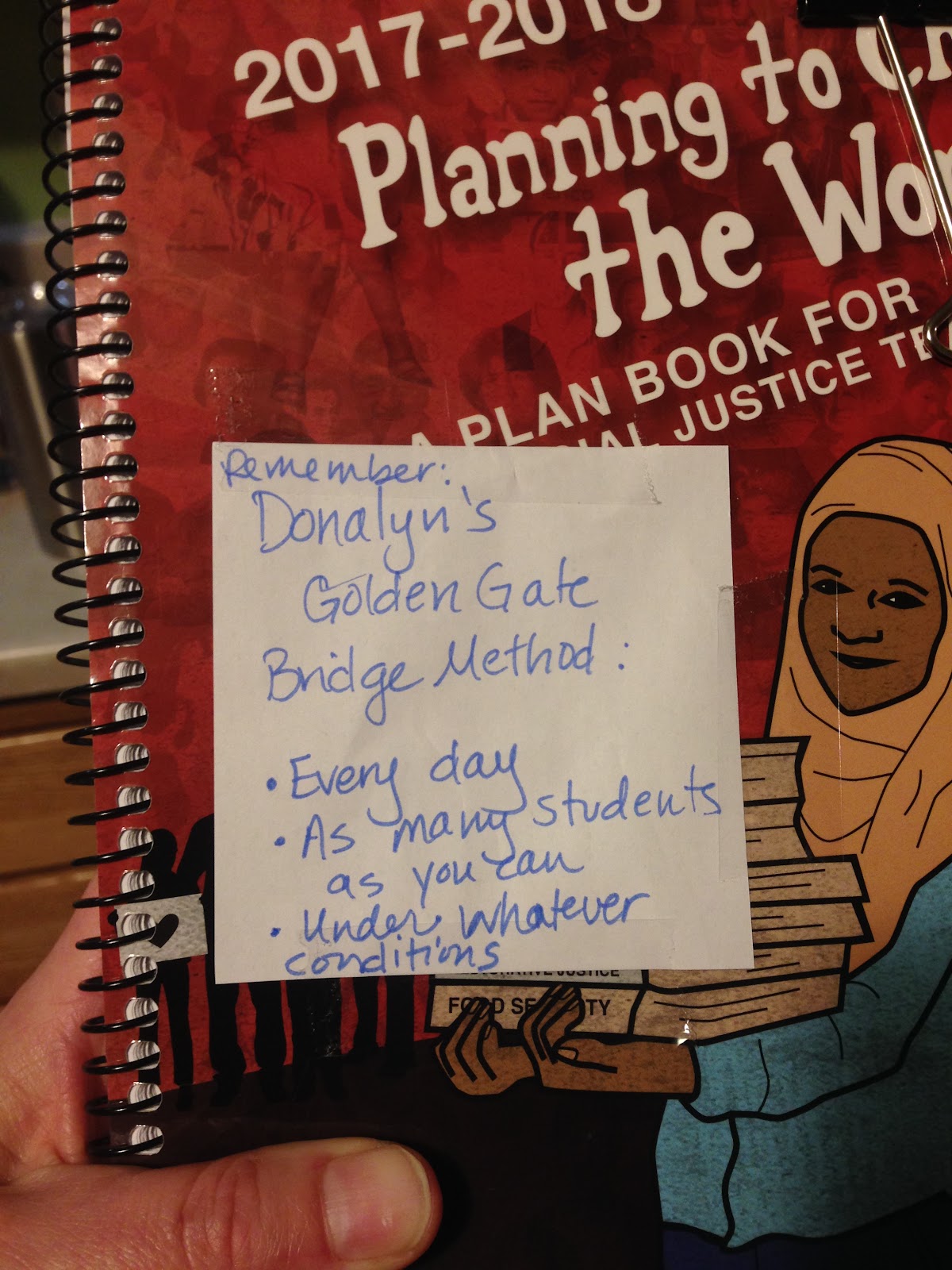
My conferring reminder
Sometimes I confer with four or five students in a day. Other times I can only get to one or two students because we are having such a great conversation about what he or she is reading or I am helping a student find a book. My biggest section has 32 students, and I confer with them all, even if it is as not as many times as I would like to.


Yes, at times other students are off task (and not always reading) when I am conferring with a student, but I believe that one-on-one time conferring is still worth it.  


I don’t have a fancy system for conferring. I use a plain composition notebook for each class. In each conference I record the date, the student’s name, the book the student is reading and the page that he or she is on. Finally, I often write what I notice about that student as a reader and as a person. My favorite questions to ask students when I confer with them about books include:
  • What's worth talking about?
  • Catch me up. What's going on?
Kneeling down next to students sitting in desks or sitting next to my students on the floor (yes, next to my high school seniors), has been incredibly rewarding. I believe that it is the conferring that has made the biggest difference in success of independent reading so far this year and in the relationships that I have built with my students. Conferring gives me a better sense of who each student is as a reader and learner. It is also how I have discovered what my students really care about and what is going on in their lives.

I am eager to discover even more about each of my students as a reader and as a person as the year progresses. In addition, I am eager to continue to learn from the Book Love Community so I can continue to serve all of my students better.
Slice of Life Challenge #23: Day 31/31: March Coffee Date

F or the month of March, each day I am writing and posting  a slice of my life , hosted by  Two Writing Teachers .  Slice of Life Challenge ...