Showing posts with label Writing about my Past. Show all posts

Thursday, March 16, 2023

Slice of Life #23: Day 16/31: Rambling Autobiography

For the month of March, each day I am writing and posting a slice of my life, hosted by Two Writing Teachers. 
Slice of Life #23: Day 16/31: 
Rambling Autobiography

You may be familiar with Linda Rief's writing prompt of the Rambling Autobiography. She suggests to write as quickly as you can for two to three minutes. Here's a bit of mine...

I was born in the mid 1970s, a time when bell bottoms and high-waist jeans were in. I often wore my brother and sister's hand-me-down clothes, or my mom sewed dresses for me. I had clothes designated for play, for school, and for church. My neighbor Andrea and I often covered the sidewalks with colored chalk, biked down to the community pool (without adult supervision), and played Ghosts in the Graveyard in the park across the street. One of my childhood bedrooms had one orange wall, three white walls, and blue carpeting. It was perfect for a rainbow themed room. My favorite activity was roller skating; I forever had holes in the knees of my pants for all of the times I wiped out. Our golden retriever, Sandy, was named after the dog in the movie Annie. On weekends, sometimes our family watched a movie in the family room. Mom would lay out a plastic checkered tablecloth on the carpeting, and we had a popcorn and cheese picnic. In fifth grade I made a small quilt for a 4-H project. Later, when I was in high school, I made a twin sized quilt. In sixth grade I wrote a novel on an electric typewriter. I went to church camp most summers and later worked at the same camp as a summer job. In ninth grade a poem I wrote was published in a magazine. I played the piano in elementary school and later the flute for nine years. As an adult, I regret that I didn't continue to play piano or flute. Maybe some day I will pick it up again. I am a teacher who writes. At 46, I am still learning how to write. I am still learning how to teach writers. 

Have you ever tried writing a rambling autobiography? If you are looking for a great writing resource to use with students, try The Quickwrite Handbook. It's wonderful. I just realized that Linda Rief has a new book out - Whispering in the Wind. Has anyone read this?

Tuesday, March 29, 2022

Slice of Life #22: Day 29: Rambling Autobiography of a Pastor's Kid (PK)

 For the month of March, each day I am writing and posting a slice of my life, hosted by Two Writing Teachers. 


Slice of Life #22: Day 29/31:
Rambling Autobiography of a Pastor's Kid (PK)

As a child of a United Methodist minister, I was a PK - that is, a pastor’s kid. I grew up in parsonages. This meant that we lived in a house owned by the church my dad served. Most of the homes were nice and well-maintained, but we had to go through a church committee to make changes (for even simple things like painting walls). For this reason, I couldn't tack Bop posters of stars like Kirk Cameron on my walls like all of my friends did. Mom and Dad were insistent that we took care of the parsonage as best as we could and to leave it nicer for the next pastor and their family who lived there. We moved about every five years, and I forever felt like the new kid. 

In church, we usually had to sit towards the front of the sanctuary. As a kindergartner and well through third grade, I was often told to sit like a lady and to stop my incessant chatter. I was scolded not to turn around and look at others during service. As Dad delivered the weekly sermon, my mom kept me occupied by handing me a church bulletin and a pencil. She would select a letter. Next I circled as many of said letter that I could find. Later she taught me the Dots game. When I got to be around fifth grade I was able to help out in the church nursery during the church service, which I gladly accepted.

Our family sometimes had church members over for dinner. It was not unusual for my parents to host a church meeting in our living room. On those occasions, my siblings and I were required to be on our best behavior and made polite conversation with folks decades older than we were. Sometimes I was asked to play the piano or flute for guests. 

I was raised on huge potluck dinners and ice cream socials following service in the church basement. At least once a month we stood in a long line that snaked all the way back to Sunday School rooms. We began nearly every potluck dinner with the Johnny Appleseed Grace. I particularly enjoyed all of the marshmallow jello salads, homemade breads, and tater tot casseroles. 

My dad was rarely home on weeknights since it seemed like he always had meetings at church. By the time I was school age, if my mom had something going on, I was sent to church with my dad. This meant that I got to play hide and seek or race with my siblings or friends in the sanctuary, trying not to get scolded by the elders. When I was asked to hang out in my dad's office, I loved looking at the collection of Bibles, crosses, meaningful gifts and handwritten notes from parishioners. An assortment of stoles were always hanging in the corner of his office. I liked to feel the heavy fabric against my skin. 
This was a cross that hung in my dad's office, a cross his mother gave him soon after he was ordained.
It now hangs in my house. 

From about second grade through eleventh grade, I went to church camp for at least one week every summer. By far, it was my favorite week of the year. I loved camp fires, swimming in the lake, singing songs, and taking hikes. Each year I returned home with tons of mosquito bites, sunburn, and religiously themed crafts. From the summer after my senior year of high school to the senior year before college, I worked at the same church camp as a summer staff member. I still have the best memories of spending my summers on staff. 

There were definitely times that I didn't appreciate being a PK. I didn't love that most people made unfair assumptions of who I was. I was often held to a higher standard than many other kids who went to the same church. I didn't love that nearly everything was influenced by the church schedule. However, both of my parents were (and still are) loving and generous people. I was surrounded by kind families and easily saw what being a part of a community meant. 

Thursday, March 7, 2019

March Slice of Life Challenge Day 7: I remember

For the month of March, each day I am writing and posting a slice of my life, hosted by Two Writing Teachers. 


March Slice of Life Challenge Day 7: I remember...


Writer Natalie Goldberg has some fantastic, practical ideas of how writers can live a writerly life in her book Wild Mind: Living the Writer's Mind. On page 10 Goldberg writes:

"Do a timed writing for ten minutes. Begin with "I remember" and keep going. Every time you get stuck and feel like you have nothing to say, write, "I remember" again and keep going. To begin with "I remember" does not mean you have to write only about your past. Once you get going, you follow your own mind where it takes you....The memory can be something that happened five seconds ago. When you write a memory, it isn't in the past anyway. It's alive right now." 


On Wednesday I used this question to fuel some writing in my writer's notebook. Writing nearly two full pages, I was surprised what my mind uncovered in only ten minutes. Since my daughter was home sick from school on Wednesday and I stayed home to care for her, I wrote about remembering the time I had mononucleosis as a sophomore in high school and missed way too much school. I remembered being so tired that I could barely function; I attended only one class each day (math) for over a month. To make matters worse, I had an enlarged spleen and couldn't participate in a church youth group trip that I participated in each year. 

I hadn't thought about having mono in ages. 

My I remember exercise also led to writing about one of my childhood bedrooms, how we packed up our boat to save room in the car when we went on summer vacation to my grandpa's cottage, and how I didn't realize how introverted my dad was until I was an adult. 

Ten minutes of writing opened up all kinds of things to write about and for all kinds of "seed ideas" for another time.

Friday, January 11, 2019

Pieces of My Writing Journey

When I was about eleven or twelve, my dad noticed that I was always buried in my spiral notebook: mapping out stories, creating poems, sketching cartoons, generating lists of characters, writing as much down as I could. Pencil to paper. Always. Being the kind of dad who never missed the opportunity to find a treasure at a yard sale, one day he bounded into our house donning a huge grin about his newest gem - a manual Smith Corona Typewriter. 

My second-hand Smith Corona Typewriter proudly held a spot on my student desk, complete with notepads and pencils surrounding it. Following my daily walk home from school and a substantial snack, I often retreated to my typewriter. I loved the loud clack clack of the keys, the smell of correction fluid, and even pride in owning a typewriter. Most of all, I cherished my time alone nested in my room writing. A few years later I received a new electric typewriter and alternated between using the electric and manual. Throughout middle school and high school, I always found time to write - especially poems, short stories, a few very bad novels, and of course, several research reports. 

In college, I continued to write most days, but little of my writing was personal. Instead my academics took priority, and I wrote research papers, literary analysis, lesson plans, and persuasive essays. Upon graduating from college - also around the time my parents moved - I sold both of my typewriters at our yard sale. I figured that I wouldn't need them anymore since I now had a desktop computer. 

Unfortunately, when I sold the typewriters, I also set aside my personal writing. Of course I had plenty of pens, paper, notebooks, and a desktop computer, but I did not make any time for writing. After all, I was busy - first as a newly minted English teacher, then a wife, next attending graduate school, and finally parenting. 

For at least a decade I forgot how much I loved to write.   

It wasn't until I was in my mid to late thirties that I began writing again. As a part of learning how to be a more effective teacher of writers, I realized that I needed to be a writer myself. Bit by bit, I came back to writing - first creating a writer's notebook for a part of a local training from staff developers of The Reading and Writing Project. Around the same time I discovered the work of Kelly Gallagher, and I starting writing with my students. Several years later, when I became a literacy coach, I began doing a lot more reflecting in my beliefs as a writer and teaching colleagues about writing. 

In the last five years I gradually added back daily writing. Not for any assignments or term papers or because I wanted to write with my students. I carved out time to write just for me. 

It took me a while for me to get into a strong daily writing routine, but now I write at least three full pages a day. My daily writing isn't always uninterrupted or even a place by myself, but I have fiercely held on to my writing routine. 

In retrospect, I wish that I had hung onto my typewriter, especially the manual one. Maybe I would have continued writing. Maybe I would not have stopped writing. This cannot be changed. 

What I am most grateful for is that I came back to writing. 

Tuesday, May 15, 2018

Slice of Life Tuesday: Junior High Physical Education Uniform


Join me in writing and sharing a Slice of your Life with Two Writing Teachers.

As the school year comes to an end, I am inviting my high school seniors to reflect on school experiences through micro writing. Below is a 100 word story I wrote to provide as a model to my students. As shared on this week's Slice of Life Tuesday Post, "If we are asking students to take risks, we have to model risk taking" (shared by Meredith Sinclair at the first Connecticut Council for Teachers of English Convention, 2018).

Check out one of my school experiences below in exactly 100 words:

Although over twenty-five years have passed, the required physical education uniform still makes me recoil. All females were required to wear one piece gym suits. No exceptions. Red shorts attached to red and white horizontal striped tops. Durable, itchy polyester. Each girl's last name was carefully printed in thick black sharpie on the left shoulder - a ceremonial duty bestowed by the physical education teacher the first day. On the last day of eighth grade I happily chucked it in the school dumpster. Raised in a fairly frugal household, it was the only item of clothing I ever remember throwing away.

I found this image somewhere on Pinterest.
Although this is not exactly like our gym suits, it is similar. 

Sunday, March 25, 2018

Slice of Life 2018 Day 25: Rainbow Quilt

My mom is an incredibly talented quilter. She began quilting as a newlywed. When she first learned how to quilt, she didn’t have any fancy tools. She used cardboard pieces as templates. Mom pieced fabrics together on her second-hand Singer sewing machine and then hand quilted intricate designs, no matter the size of the quilt. I literally cannot fathom how she made time to quilt, especially when she could not have had much time for herself.

As we grew up my mom continued to quilt. Mom made a stunning quilt as a gift for our wedding, gorgeous baby quilts for each of my children, and later twin-sized quilts for each child. In her retirement, she is active in her quilting guild, often enters her quilt in local quilt shows, and is an avid member of a mission quilting group at her church.


I love sleeping and snuggling under quilts she made for me - constant reminders of the love and care she stitched into each.

Below are two of the quilts she made for my children:


A cuddle blanket for my daughter

A quilt for my son's bed, some fabrics remnants from our wedding quilt. 
One of the memories that stands out for me from childhood involves a quilt Mom secretly made for me as a birthday gift. When I was about five or six years old I threw a tantrum in a department store for a rainbow comforter that we couldn’t afford. My mom designed a pattern similar to the comforter I wanted and made it for me. I wrote about this memory in this fifty word story:


“If you loved me, you’d buy me that rainbow comforter.” Seven-year-old Trina pleaded with her mom. Too much, Mom dimly replied.


“I never get anything new.” Ungrateful little imp.


At her next birthday, Trina opened a handstitched rainbow quilt from Mom-one she’d secretly worked on while her little girl slept.

Saturday, March 24, 2018

Slice of Life 2018 Day 24: What My Childhood Tasted Like

In search of some inspiration for today's Slice of Life post, I turned to Amy Krouse Rosenthal’s Encyclopedia of an Ordinary Life. I thought about writing an encyclopedia entry, but as I was paging through this familiar book, I noticed that she includes many tables in her writing - sources that I had never considered emulating before.

Below is a table called “What My Childhood Tasted Like” (on page 59 of my paperback of Encyclopedia of an Ordinary Life). It is a simple T-Chart. On the left hand side is the item from her childhood and the right hand side is ARK's notes about it.
AKR's Taste of Childhood Table 

I immediately found myself thinking about my childhood tastes and got to work making my own childhood taste table.
Trina's Taste of Childhood table 

(Note: I couldn't figure out how to properly include a chart on Blogger without distorting the words, so here is a link to my full chart of childhood tastes.)

I think about food probably a lot more than I should, but I hadn't thought about writing about food in this way before. Creating this chart conjured so many fond memories, and I could easily elaborate on just one of these ideas in a poem or short story. I found it to be a playful way to come up with new seed ideas to write about.

Saturday, March 17, 2018

Slice of Life 2018 Day 17: Baptismal Gown

Many children’s books are filled with stunning words and phrases, worthy of using as a mentor text with students of all ages (including high school students). Cynthia Rylant’s work is no exception. Cynthia Rylant’s Something Permanent is a gorgeous book that tells stories of ordinary Americans living in the Great Depression through Walker Evans’ photos and Cynthia Rylant’s poetry. Each black and white photo is accompanied with a corresponding poem.

Something Permanent reminds me that photos are a fantastic source to conjure memories. Photographs help preserve moments, of both ordinary and important events. Words, often through poetry, can enhance an image. 

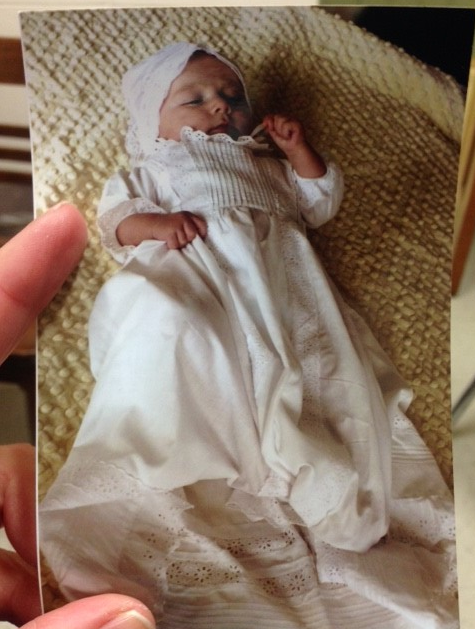
My grandma Geanne, now in her mid-nineties, moved into an assisted living situation last summer. As my mom and aunts were helping her downsize from her house to her much smaller room, they gathered important letters, photos, and other mementos that she would not have room for. Around Christmas my mother handed me a bag full of old photos and letters from Grandma Geanne. It was bittersweet to read letters I had written to my grandma from when I was in elementary and middle school and to see photos of me and my own children in her collection, some of them unfamiliar. One of the photos was of my daughter on the day of her baptism.
My daughter in the family baptismal gown
Instantly, I thought of the gown my daughter was wearing. She's donned in the same gown my mother wore, I wore, her older brother wore, my siblings wore, my cousins and nieces and their children wore. A favorite part of my daughter's baptism was dressing her in a gown that is nearly one hundred years old that was made for my grandmother. I cherish the love that my grandma put into caring for this family heirloom.

In honor of Grandma Geanne, I wrote a poem about this baptismal gown. Something Permanent provided the perfect format to emulate.

Baptismal Gown
She wanted to be certain her hand-sewn baptismal gown could be
preserved for each child, grandchild, and great-grandchild,
so she kept this fragile gown folded in white tissue paper
in a flimsy department store cardboard box, secured with string,
high on the top shelf of her closet,
and when the time came
she hand-washed,
pressed, and
delivered
this  
gown
for each
baby.

Wednesday, March 14, 2018

Slice of Life 2018 Day 14: Changing the Narrative

I have been following Mari Andrew on Instagram and Twitter for a while. I adore her drawings and especially how she shares such vulnerable thoughts. She recently posted this image on Instagram:

Mari's post on Instagram
I thought that it might be an interesting mentor text to emulate. Below is my version (open this link if you cannot read the small print):


My two narratives

As I was crafting my parallel narratives, I enjoyed considering different perspectives of my past, especially in considering how my struggles helped me in ways that I didn't initially consider. This may be a writing exercise I use with my students, especially since I have a large number of students who have experienced trauma.


Sunday, March 11, 2018

Slice of Life 2018 Day 11: Rummikub and Tanka Poetry

Lately, and to my delight, my children and I have been spending more time playing games together at our kitchen table. This winter one of our favorite games to play has been Rummikub.
The version of Rummikub I played with my grandparents
Each time I play Rummikub, I cannot help but think of my grandparents, who taught me this game when I was young. Today’s post celebrates playing Rummikub. I’ve been playing around with writing Micropoetry lately, so I decided to create a Tanka poem, a thirty-one-syllable Japanese poem. You’ll notice that I actually created a double tanka poem for this slice.


Childhood memories
Visiting Minnesota
grandparents - often
We gathered, played Rummikub
As they spun tales of their youth.

Chills this winter brought
Out familiar Rummikub -
Teaching strategy,
Conversation conjured fond
Visions from time long ago.
My daughter playing Rummikub

Friday, March 9, 2018

Slice of Life 2018 Day 9: Thinking Through My Fingers


A popular quote from Isaac Asimov
To me, writing IS thinking. I am amazed when I write about something and later realize that my thoughts have been altered in the act of what writer and professor Isaac Asimov once called, “thinking through my fingers.”  


The 100-Word Story I posted yesterday was based on a familiar memory from my childhood. My defiance was often brought up by members of my family at the dinner table with gentle teasing. It is a story that I have shared with my own children as a cautionary tale.


Although I have thought about this story many times, it wasn’t until I was writing about the nail polish incident that I considered my mom. At the time I remember feeling so angry when I was told that I could not paint my nails. I did not understand why my mom told me no, especially when I had painted my nails before without an issue. As the youngest kid in my family, I felt like I was forever being told that I couldn’t do something: I was too little, there wasn’t enough time, it wasn’t my turn, I needed to practice more patience. As I think back, my mom would have been at work for most or at least part of that day, she would have encouraged us to do homework and practice instruments (no easy feat), she would have prepared a meal for us, and she would have cleaned up after dinner. When I asked about polishing my nails that night, she would have probably been in the middle of getting everything ready for the babysitter. I am sure that she was exhausted before the babysitter even arrived. As a parent now, I completely understand why she told me “no” to polishing my nails. I can just imagine when my mom returned home from her meeting, noticed that I wasn’t sleeping as she expected, and then, to her horror, when she realized I had, indeed, polished my nails, leaving traces of bright polish everywhere. I am sure that scrubbing nail polish off of the carpeting and bathroom counter was the very last thing that she wanted to do that night.


Would I considered my mom’s perspective if I had not taken the time to write about it?


I am reminded that it would be wise to apologize to my mom for the nail polish incident the next time I see her. It’s over thirty years later, but I am positive that she would appreciate that I finally considered her perspective.


This is one of the many reasons I write - to help me uncover new perspectives. Here is a Haiku I wrote yesterday in reflection:


Thinking through fingers
Of childhood events cause me
To pause...wonder...change.


What perspectives have you considered when you have participated in “thinking with your fingers?”

Wednesday, March 7, 2018

Slice of Life 2018 Day 7: Grappling with Literary Shock

"Life is a constant struggle between being an individual 

and being a member of the community." 

from The Absolutely True Diary of a Part-Time Indian 

by Sherman Alexie


It was about 2008 when my colleague Jamie Hietpas introduced me to Sherman Alexie’s The Absolutely True Diary of a Part-Time Indian. She enticed me by asking me to read the first two pages and commented something like, “I just couldn’t put this down until I finished reading it. It’s so funny, so sad, yet SO good.” I borrowed Jamie’s copy and found myself immersed in this book for the next few days - a feverish read.

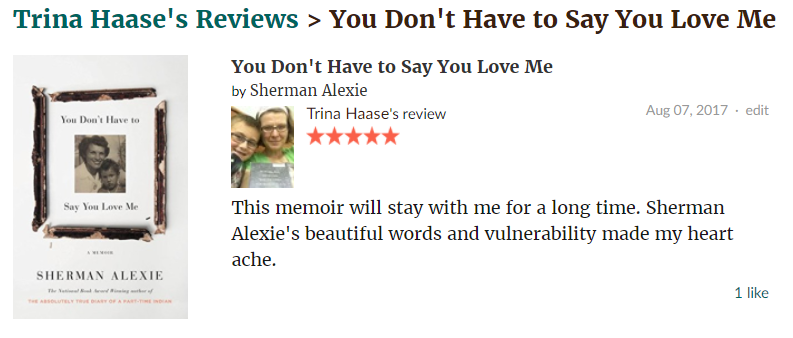
Just last August I devoured You Don’t Have to Say You Love Me, Sherman Alexie’s latest book, leaving this review on my Goodreads page:


My brief review of You Don't Have to Say You Love Me

You Don’t Have to Say You Love Me was one of my favorite books that I have read in a long time, and I have recommended this title to many readers, including older high school students, colleagues, and friends. In addition, his honest voice and vulnerability is what I have loved about his writing the most. Alexie does not portray himself as perfect in this memoir. In fact, sometimes I “lifted a line” from this book to help inspire my own writing. I even studied a few of Alexie’s lines as mentor sentences.


Monday I was caught off guard. This article popped up on my Facebook feed. As I searched the Internet I dug in deeper, including an article from Indian Country  including these words one woman said about Sherman Alexie in the title, “He’s poisonous.” Jaw dropped.

I couldn’t help but feel disappointed, almost betrayed when I read the details of the accusations.


Alexie has been accused of using his literary status and power over women, especially aspiring female writers. He recently (and vaguely) addressed these accusations, as reported in this article from The Oregonian.


I’ve been in situations before when I have felt overpowered. When I was in high school I was mistreated by a manager at a local restaurant where I was working. A co-worker stood up for me and notified our boss. I briefly wrote about it here in a 50 Word Story. Although I was assured by my boss that I did nothing wrong, and he told me that he was glad that he knew about the sexual harassment so he could take action to protect me and others, I still felt ashamed, as it was somehow my fault. Truly, I have been fortunate to escape some of the horror that many women (and other individuals) have endured regarding sexual harassment/assault, yet the incident I referenced earlier truly messed with my mind.


No one should be put in a position where someone holds power over them. We need to make dramatic changes so it is not so common to have a #metoo story.


Yesterday these lines from one of Sherman Alexie’s most recently published poems, “Hymn”, popped out at me:
A line from "Hymn"
And I ruminated over these lines fromThe Absolutely True Diary of a Part-Time Indian,
"There are all different kinds of addicts, I guess. We all have pain. And we all look for ways to make the pain go away." 

Honestly, the accusations towards Sherman Alexie shocked me. Immediately, I thought about my students who are currently reading his books, and I began wondering if I should share this information with my students. Of course I’ve taught and recommended books before to students who were written by less-than-perfect authors. I feel a little silly even writing about this since I have never met Sherman Alexie in person or even heard him speak. Yet, I felt like I knew Sherman Alexie by his writing. I didn’t think that he was someone who would sexually harass women. Maybe I am just that naive.  


Ultimately, these are questions that linger in my mind today, ones that I need to wrestle with a little longer:
  • How do I talk about this with my students? Should I? 
  • Can I continue to adore Sherman Alexie’s writing, despite what I know about these accusations?
  • What do I do when Sherman Alexie’s books are reaching my most vulnerable learners?
  • Do I emphasize the writing or the writer?
  • Are some acts worth forgiving?

Slice of Life Challenge #23: Day 31/31: March Coffee Date

F or the month of March, each day I am writing and posting  a slice of my life , hosted by  Two Writing Teachers .  Slice of Life Challenge ...