Showing posts with label Sam Bennett. Show all posts

Wednesday, February 13, 2019

Book Cover Challenge

Book Cover Challenge

Recently I was invited by my friend Cris via Twitter to post seven covers of books that I love - no review, but just the cover. The challenge requested that each time I posted the cover I was supposed to invite someone new to accept the challenge. I was excited, yet a bit apprehensive. I knew not everyone I tagged would participate (they didn't) and that many of my pals on Twitter had already participated in the same/similar challenge. However, I have loved seeing book covers posted during this challenge, adding many to my to-be-read pile (like these titles: Several short sentences about writing, The Worlds of Harriet Henderson, Heart Talk)

For me, the hardest part of this challenge was not writing anything about books I love. If you couldn't guess, I adore books - reading them, talking about them, writing about them, and simply being surrounded by them.

Below is a bit about each cover I posted in the challenge and what I love about each title:  

Voices in the Air by Naomi Shihab Nye
Naomi Shihab Nye is one of my favorite writers. This is a book that I turn to when I want to find writing inspiration or even for a bit of personal comfort. Her writing is stunning, often bringing out tender emotions when I read her work. Once I heard the author share on a podcast that she often shares with students that we live in poems. Since then, I often think about how we live in poems. 


A Book of Uncommon Prayer by Brian Doyle 
I learned about writer Brian Doyle at one of teacher/author Katherine Bomer's brilliant presentations. I own many of Brian Doyle's books, but one of my favorites is A Book of Uncommon Prayer. What I love most about this book is it reads like a collection of list poems in celebration of the most ordinary things. Ultimately, it is about taking time to notice what's around you and writing about it. This is a book that has served as a mentor text to me before. It's also helped me show up with more gratitude, especially with I am going through something heavy. The late Brian Doyle was an exquisite writer. 


The Journey is Everything by Katherine Bomer
Katherine Bomer's work deeply changed me as a teacher, especially as a teacher of writers. Although I hate to admit this, I used to approach teaching writing through more of a deficit lens. I focused on what students could not do in their writing. I used to teach the dreaded five paragraph essay. I wasn't celebrating what my students could do as writers. The Journey is Everything challenged many of my traditional secondary teacher views; It helped me approach teaching writers in more authentic and purposeful ways, and I learned how to use mentor texts more effectively. The Journey is Everything was one of the books that sparked my journey as serving my students better as writers. 


The Last Report on the Miracles at Little No Horse
by Louise Erdrich
A few years ago a wise woman I know introduced me to an impressive array of new-to-me titles and authors. Her suggestions expanded my reading diet, changing me as a reader and person. One of the titles on this list was Louise Erdrich's The Last Report on the Miracles at Little No Horse. By far, this is one of my favorite pieces of fiction. I lingered in Erdrich's beautiful prose and story telling and cared deeply about the characters in this book. Over two years later I still think about this book- how Erdrich's characters dealt with grief and spirituality and about the power of community and humor and forgiveness and redemption. The book also made me think about all of different ways to show and receive love. Just thinking about this book makes me want to reread it. 


That Workshop Book
by Sam Bennett
I was initially drawn to That Workshop Book because of the cover. Yet, the inside is just as great (if not better) than the cover. Although I had read books about the workshop model before, this is the first book that really made sense to me as a teacher and literacy coach. Sam Bennett's writing voice is lovely, inviting, and compelling. She introduces you to remarkable classrooms you want to be a part of. Sam Bennett's work helped me be a smarter instructional coach and teacher. She inspires me to want to keep learning in order to serve my students better and to show up as a better human. When I'm struggling as a teacher, especially in planning and creating meaningful work for my students, I reread this book. It always leaves my soul a little fuller.


A Velocity of Being: Letters to a Young Reader
edited by Maria Popova and Claudia Bedrick
I've been an avid follower of Maria Popova's Brain Pickings for a while now. When A Velocity of Being was published I immediately purchased it. This book is filled with gorgeous illustrations, paired with lovely letters to young readers. This is a title that I have been slowly reading just so I can savor it a little longer. My ten-year-old daughter and I have been marveling at this volume, frequently looking up artists. Later this year I hope to use this book as a mentor text with students, integrating art and writing.
  

The Tiny Book of Tiny Stories: Volume 3
by Joseph Gordon-Levitt

I first heard about The Tiny Book of Tiny Stories on a teacher blog post (I think from Three Teachers Talk). It is a small volume of tiny stories, accompanied by artwork. I am always searching for possible mentor texts to use with my high school students. This title reminds me that story doesn't have to be long or complicated to be meaningful or poetic. Some stories are quirky and unexpected, while some I found thoughtful and touching. The Tiny Book of Tiny Stories is a quick and fun read; It's often checked out from my classroom library. 


 ********** 
There were many covers that I could have (and wanted to) include in this challenge. Most importantly, this was a great way for me to think about some beloved books and share them. 

Thank you, Cris. 

As Rainer Maria Rielke once remarked, "Ah, how good it is to be among people who are reading." 

Touché, Rainer Maria Rielke. 

Friday, March 23, 2018

Slice of Life 2018 Day 23: Golden Lines - On Writing

In the summer of 2016, in my former role as a secondary district literacy coach, I led a professional development session to middle level and high school English Language Arts (ELA) teachers in my district on best practices in teaching adolescent writers.

I wanted to lead a session that wasn't just me talking and telling. I wanted participants to be engaged. I yearned for teachers to leave with new learning and insights.

I ended up setting up this session like a workshop, providing participants with choice and inviting them to make something meaningful. You can see my plan here. I designed this staff development session based on what I learned from Samantha Bennett, who graciously guided me in developing it. (To me, Sam Bennett and Cris Tovani's explanation and examples for how to plan for and instruct using a workshop model makes the most sense. Check out Sam's That Workshop Book and Cris' So What Do They Really Know? for more on workshop.)

In the first part of the session I invited teachers to read an array of professional materials about teaching writers. I shared resources from some of my favorite teacher authors, including Katie Wood Ray, Katherine Bomer, Ralph Fletcher, Nancie Atwell, Penny Kittle, and Kelly Gallagher. In addition, I provided books on writing by Stephen King, Anne Lamott, Georgia Heard, and Natalie Goldberg. Participants could select which resources to read and determine what pieces that they were the most interested in.


A few of the writing resources I shared with teachers. 
As teachers poured through materials, I asked them to collect golden lines, or lines that particularly resonated with them. After teachers collected golden lines, I instructed them to star or circle one or two of their favorite lines. Next, each teacher shared his or her top golden lines with a small group and later with the large group. Based on conversations they had with each other about their golden lines, teachers were invited to add lines they heard about from their colleagues to their own list.

Finally, I asked each participant to create a writing manifesto based on the collection of golden lines or ideas based on what they read. The idea was that if teachers could create a writing manifesto, then they could articulate their beliefs on best practices AND be able to support their beliefs with theory or research.


Prior to leading the staff development session, I created two samples to share with teachers. Below is my writing manifesto, based on a collection of golden lines from my favorite teachers of writers:
We live in the world as writers, searching for and capturing ideas for writing.
Writing is a process and by focusing on the process and habits of a writer, writing improves.
Good things happen when writers are able to articulate what they are doing and why.
The daily practice of craft sharpens the writer’s vision and tunes the writer’s voice.
The more you do it, the easier it becomes for you to continue to do it and the more you learn about how it gets done.
No matter where we start as writers, we can reach for more.


*********

I also wrote a poem as a different way to communicate my beliefs about writing. You can read it by visiting this post.

Collecting golden lines gave teachers the opportunity to write a manifesto similar to how someone would create a found poem. However, had the option to create his or her writing manifesto using any format desired. Honestly, the format didn't really matter. What mattered most was that teachers thought deeply about their practices in writing and how he or she synthesized that information in order to make positive change for writers.

At the end of the morning session, teachers shared their writing manifestos in small groups and a few shared in the large group. This led to a fantastic discussion about instructing writers. This was, by far, one of the most powerful staff development sessions that I have ever led. All of the high school and middle level teachers were engaged. Many commented that they appreciated making something that mattered to them. I encouraged all participants to hang their manifestos in their classrooms or where they plan as a reminder that our beliefs about teaching writers matter for planning.


Nearly two years later, both of my manifestos (my poem and my collection of golden lines) hang near my computer at school. They are daily reminders of what I strive to do as a teacher of writers.

Sunday, October 8, 2017

The Energy to Teach

Confession: the last two weeks of teaching have not been my finest. One of the worst days was when one of senior high school students was disrespectful to his classmates and me. When I tried to gently address this with him, he announced yelled to the whole class, “I hate this class! I wanted Ms. ________ and instead I got you! This sucks!” He walked out of my classroom before I could say much more. Meanwhile, I heard another student say under her breath, “Senior year is supposed to be fun. Can’t she loosen up?” Defeated, I observed the rest of my students. Prior to his outburst, I had been individually conferring with students on a piece of writing. As I scanned the room, I noticed that many of my students were doing anything but working on writing - they were on their cell phones (not as an academic resource, as I had requested, but probably Snapchatting or texting), and one student was intensely applying her make up instead of writing. That morning I left class feeling so frustrated, wondering, why did I leave my position as a literacy coach for this?


These student comments and my observations hung heavy on my heart all day.


That night, as I wrote in my notebook, listing as much as I could remember, especially about that class hour. Although writing about a challenging event often makes me feel better and provides me with a better perspective, this time I felt worse, my inner critic loud and harsh. In an effort to try to focus on what's been positive in my teaching, I made a list of what I felt like I have been doing right in this classroom so far, and it looked a little like this:
  • I’ve been writing with and in front of my students every day.
  • I’ve been providing them time each day for independent reading and time for writing.
  • Students have choice in what they are reading and writing.
  • I have been individually conferring with students in both reading and writing.
  • Most days I have provided a daily agenda and specific learning targets.
  • I’m giving and getting feedback from my students each day.
  • Students have many opportunities to talk with each other in partnerships and in small groups.
  • I encourage students to write about what is meaningful to them.


I knew that I was applying best practices in teaching, all that could be backed by research, but I couldn’t help but wonder, what was I doing wrong? So many of my seniors acted like they just didn’t care about learning anything. True, I wasn’t the beloved teacher that many of them wanted for their teacher, but I couldn’t change that. They couldn’t do much about it either.  


As I wrote, I thought back to a teacher (I'll call her Ms. Smith) whom I had been working with in a coaching capacity a few years earlier. Just like me, Ms. Smith was frustrated with her students after a challenging lesson. She didn’t know what to do next or how she could possibly teach them. My first impulse was to give Ms. Smith a long list of things that she could try with her students, but I knew that listing off what I knew probably wouldn't help her grow, or worse, it could backfire. In fear of saying the wrong thing to Ms. Smith (and risk ruining the coaching relationship that I had worked so hard to establish), I reached out via email to respected instructional coach and staff developer, Samantha Bennett, who I had recently seen speak at our state’s annual reading convention. Sam quickly responded to my dilemma and shared what she learned from Don Graves, particularly from his book The Energy to Teach (Heinemann, 2001). Sam wondered what the outcome would be if we approached that day as an inquiry and created a chart focusing on a few students and answering these questions:
  1. What do you know about this student as a person?
  2. What do you know about this student as a learner?
  3. What does this student know you know?
  4. Knowing this, what are your next steps?


Since I had (and still have) such a high level of professional respect for Sam, of course I dove into her query. As I worked with Ms. Smith the following day, we created and completed a chart answering these questions. As she and I filled out this chart together, it filled me with empathy for many of her students. In addition, it reminded us both how students often act when they feel threatened (and don’t want to look stupid). Later, Ms. Smith reported that she changed her approach in how she spoke with students and her interactions with them. This change made a huge difference for Ms. Smith and her students, not just the next day or week, but for the rest of the year.


In thinking about how I coached (and learned) with Ms. Smith I realized that perhaps I could benefit from participating in the same inquiry. So I created a chart in my notebook, focusing on the students who seemed to be the most outspoken and resistant to learning in my class. As I was filling out my chart, it hit me. Although I knew some things about my students, it was not enough. I could respond better to their needs if I knew more about each of them as people and as learners.


I pondered my next steps and decided that I could invite students to tell me more about themselves as learners and individuals, so I created a survey using Google Forms. Although I knew it would be probably be better to ask each student in person, this survey would at least be a starting point. A few of the questions I asked students are listed below, including what do you want me to know about you as a person and what do you want me to know about you as a learner:


A screenshot from part of my survey


Many of my students' answers surprised me. I learned more about my students than I thought I would from this survey (and most of their responses were things that I couldn’t tell from looking at their past grades or standardized scores). A few of their responses included:
  • “I have never been a good writer.”
  • “I have a lot of anxiety about school, and I wish more teachers were more understanding about my mental health.”
  • “I struggle to keep my focus.”
  • “I work two jobs and don’t get home until 11 on most nights.”
  • “English is my hardest class. I’ve never been a good reader.”
  • “My parents just got divorced, and it’s hard. I’m sorry if I am sometimes moody.”
  • “I need more examples of what to do because I don’t know what you want.”
  • "I'm worried I won't graduate if I don't pass this class."


The next two days I spent following up with students whose comments I didn’t understand or wanted to comprehend better. One of my students wrote, “I wish I knew what your adjective was.” I was so perplexed when I read her comment, but as I spoke with her, I quickly realized that she meant objective, not adjective. And of course, many of the conversations I had with students were hard. One student asked me if I could just hand out a packet of work (like he was used to in other classes). Another student told me that she was afraid that I was going to teach one thing and expect another when it came to grades (ah, the “gotcha” grade). In response to using an assigned seating chart, a few students inquired why I didn’t treat them more like adults and let them sit where they want. A different student told me that he didn’t understand why I needed to meet with students so much because he didn’t feel that he needed to work on his writing - finishing the draft was enough. Finally, a few of my students told me that they didn't care that they could read or write well because they weren't planning to go to college. They just wanted to graduate from high school.

Sigh.


Overall, I am glad that I made the time for students to provide me with more feedback. I learned more about many of them and I realized that I could tweak a few things in my instruction. In listening and talking with my students, it became apparent that I need to write my learning targets in a more student-friendly manner and involve my students more often in identifying how they are meeting each learning target. I also need to continue to make time to listen to my students, even if some of the feedback is uncomfortable to read and hear.

Each day I am humbled at the complexity of teaching and all that I still need to learn in order to serve my students more effectively.

Saturday, September 2, 2017

Know Better, Do Better

Know Better, Do Better

My formal teaching career launched eighteen years ago as a language arts teacher in an urban middle school. Like most first year teachers, I struggled with almost everything - classroom management, developing units, teaching grammar and spelling, and how to assess writing. I quickly realized that having my own class was really not the same as my student teaching. I was a secondary English Education major, but I often found myself lost. I didn’t know how to help my students who refused to read. I didn’t know how to effectively teach young writers. I didn't know what to do when students wouldn't participate. I didn't now how to give fair grades to students. Yet, I pretended that I was just fine - that I knew everything I needed to be an effective teacher. There was no way that I would admit to Mrs. Wiegand, my principal, that I needed help and had a lot more to learn. I wasn’t vulnerable enough with my colleagues to ask for help either. And there was no way that I could reveal to my eighth grade students that I didn’t know something or had to search to find an answer.


I believed that I could never show weakness or appear that I did not know something. I was terrified that someone might think that I wasn’t a good teacher or didn’t belong in the classroom.


Fortunately, I don’t feel that way anymore.

A few years ago I attended a conference called Comprehension X3 in Madison, WI and I heard someone ask author and staff developer Cris Tovani about how she assessed student writing and reading using standards in her grading. Her response was something like, “I’m not there yet. I am still trying to figure that out.” I was blown away at how vulnerable she was in sharing this statement in front of a large group. I even wrote down the question and her response in my notes with an exclamation point. In a breakout session later on, Cris also shared who influenced her thinking and the titles she was reading to learn more about standards based grading. I'm sure it wasn't a big deal to Cris, but it showed me that it was okay to admit when you don't know an answer. By this time I was learning more and more about being an effective teacher (and changing my instructional practices), but I realized that I wasn't sharing this with my students or colleagues.

Recently, one of mantras has been this phrase: know better, do better. I am a completely different teacher than I was eighteen years ago. Now I read more professional resources, attend literacy conferences, and am involved in our Wisconsin State Reading Association. I take the time to reflect in my writing as a teacher and learner. Unlike my first few years of teaching, I am not afraid to ask questions, even if I know it exposes exactly what I do not know. Perhaps, and most importantly, I am a better listener to my students and understand how much they can teach me about their learning.

These are the areas that I am most interested in as a learner right now: 
  • How to teach reading more effectively to high school readers
  • How to give and get better feedback from my students
  • How to plan my instructional units better, including using learning targets better and what author and staff developer Samantha Bennett calls an effective "make"
  • How to empower student voice through writing
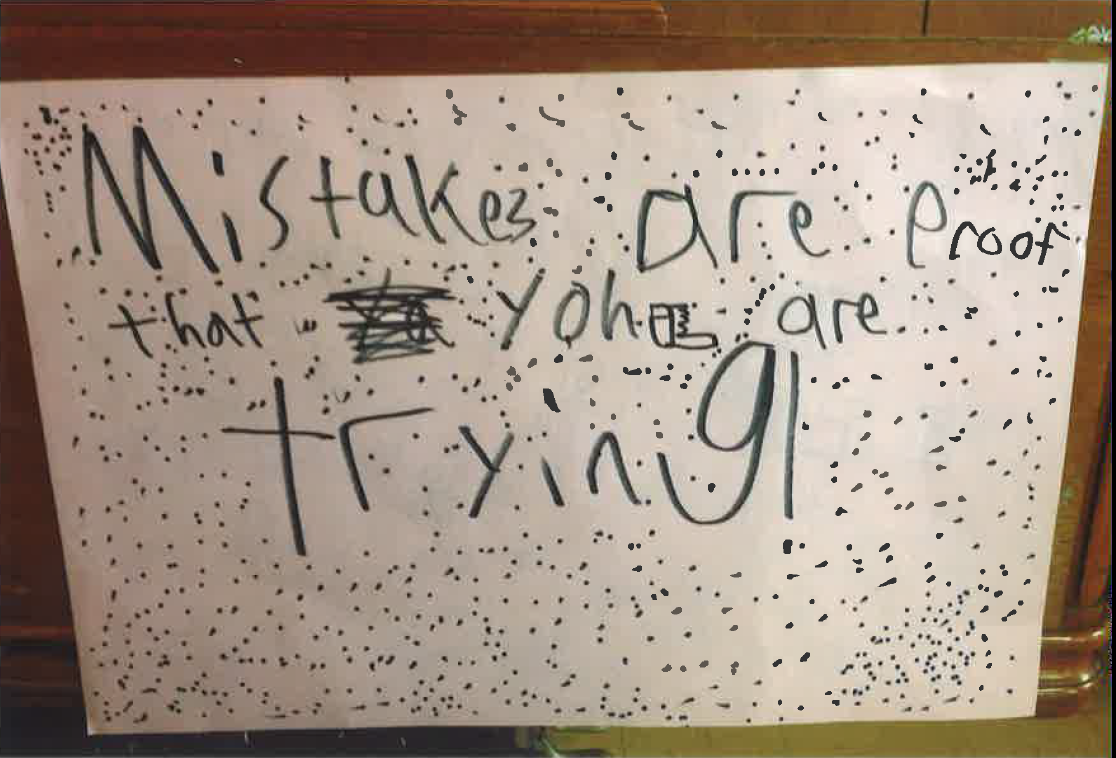
Last year a classmate in my daughter’s third grade class made this poster:
This poster was created by one of my daughter's classmates and proudly displayed in the classroom.
I couldn't love this more. I hope to show my students more of my mistakes this year so they can see that I am learning. I want them to see that sometimes I struggle in what I am doing (and don't know all the answers), but I seek out information when I don't know the answer.

I want to create this kind of culture in my high school classroom, one that values mistakes. One that shows that we are all seeking knowledge. A culture that honors that we are all learners, even the teacher.   

Know better, do better.

Slice of Life Challenge #23: Day 31/31: March Coffee Date

F or the month of March, each day I am writing and posting  a slice of my life , hosted by  Two Writing Teachers .  Slice of Life Challenge ...