Showing posts with label Cris Tovani. Show all posts

Saturday, March 9, 2019

March Slice of Life Challenge Day 9: Blackout Poetry Fun

For the month of March, each day I am writing and posting a slice of my life, hosted by Two Writing Teachers. 


March Slice of Life Challenge Day 9:
Blackout Poetry Fun


Blackout poetry, another form of found poetry, is a fun way to play with words. Using a page from one of my favorite professional resources, I Read It But I Don't Get It by the phenomenal Cris Tovani, I created this blackout poem:

Infer
Use background knowledge
with textual evidence.
Lift up words.
Think beyond the pages
Find deeper meaning.

Look for clues.
Analyze
thinking.
Unlock the door. 

(Don't worry, I would never deface Cris Tovani's work unless I was annotating. I used my black sharpie on a photo copy.)

Wednesday, February 13, 2019

Book Cover Challenge

Book Cover Challenge

Recently I was invited by my friend Cris via Twitter to post seven covers of books that I love - no review, but just the cover. The challenge requested that each time I posted the cover I was supposed to invite someone new to accept the challenge. I was excited, yet a bit apprehensive. I knew not everyone I tagged would participate (they didn't) and that many of my pals on Twitter had already participated in the same/similar challenge. However, I have loved seeing book covers posted during this challenge, adding many to my to-be-read pile (like these titles: Several short sentences about writing, The Worlds of Harriet Henderson, Heart Talk). 

For me, the hardest part of this challenge was not writing anything about books I love. If you couldn't guess, I adore books - reading them, talking about them, writing about them, and simply being surrounded by them.

Below is a bit about each cover I posted in the challenge and what I love about each title:  

Voices in the Air by Naomi Shihab Nye
Naomi Shihab Nye is one of my favorite writers. This is a book that I turn to when I want to find writing inspiration or even for a bit of personal comfort. Her writing is stunning, often bringing out tender emotions when I read her work. Once I heard the author share on a podcast that she often shares with students that we live in poems. Since then, I often think about how we live in poems. 


A Book of Uncommon Prayer by Brian Doyle 
I learned about writer Brian Doyle at one of teacher/author Katherine Bomer's brilliant presentations. I own many of Brian Doyle's books, but one of my favorites is A Book of Uncommon Prayer. What I love most about this book is it reads like a collection of list poems in celebration of the most ordinary things. Ultimately, it is about taking time to notice what's around you and writing about it. This is a book that has served as a mentor text to me before. It's also helped me show up with more gratitude, especially with I am going through something heavy. The late Brian Doyle was an exquisite writer. 


The Journey is Everything by Katherine Bomer
Katherine Bomer's work deeply changed me as a teacher, especially as a teacher of writers. Although I hate to admit this, I used to approach teaching writing through more of a deficit lens. I focused on what students could not do in their writing. I used to teach the dreaded five paragraph essay. I wasn't celebrating what my students could do as writers. The Journey is Everything challenged many of my traditional secondary teacher views; It helped me approach teaching writers in more authentic and purposeful ways, and I learned how to use mentor texts more effectively. The Journey is Everything was one of the books that sparked my journey as serving my students better as writers. 


The Last Report on the Miracles at Little No Horse
by Louise Erdrich
A few years ago a wise woman I know introduced me to an impressive array of new-to-me titles and authors. Her suggestions expanded my reading diet, changing me as a reader and person. One of the titles on this list was Louise Erdrich's The Last Report on the Miracles at Little No Horse. By far, this is one of my favorite pieces of fiction. I lingered in Erdrich's beautiful prose and story telling and cared deeply about the characters in this book. Over two years later I still think about this book- how Erdrich's characters dealt with grief and spirituality and about the power of community and humor and forgiveness and redemption. The book also made me think about all of different ways to show and receive love. Just thinking about this book makes me want to reread it. 


That Workshop Book
by Sam Bennett
I was initially drawn to That Workshop Book because of the cover. Yet, the inside is just as great (if not better) than the cover. Although I had read books about the workshop model before, this is the first book that really made sense to me as a teacher and literacy coach. Sam Bennett's writing voice is lovely, inviting, and compelling. She introduces you to remarkable classrooms you want to be a part of. Sam Bennett's work helped me be a smarter instructional coach and teacher. She inspires me to want to keep learning in order to serve my students better and to show up as a better human. When I'm struggling as a teacher, especially in planning and creating meaningful work for my students, I reread this book. It always leaves my soul a little fuller.


A Velocity of Being: Letters to a Young Reader
edited by Maria Popova and Claudia Bedrick
I've been an avid follower of Maria Popova's Brain Pickings for a while now. When A Velocity of Being was published I immediately purchased it. This book is filled with gorgeous illustrations, paired with lovely letters to young readers. This is a title that I have been slowly reading just so I can savor it a little longer. My ten-year-old daughter and I have been marveling at this volume, frequently looking up artists. Later this year I hope to use this book as a mentor text with students, integrating art and writing.
  

The Tiny Book of Tiny Stories: Volume 3
by Joseph Gordon-Levitt

I first heard about The Tiny Book of Tiny Stories on a teacher blog post (I think from Three Teachers Talk). It is a small volume of tiny stories, accompanied by artwork. I am always searching for possible mentor texts to use with my high school students. This title reminds me that story doesn't have to be long or complicated to be meaningful or poetic. Some stories are quirky and unexpected, while some I found thoughtful and touching. The Tiny Book of Tiny Stories is a quick and fun read; It's often checked out from my classroom library. 


 ********** 
There were many covers that I could have (and wanted to) include in this challenge. Most importantly, this was a great way for me to think about some beloved books and share them. 

Thank you, Cris. 

As Rainer Maria Rielke once remarked, "Ah, how good it is to be among people who are reading." 

Touché, Rainer Maria Rielke. 

Friday, March 23, 2018

Slice of Life 2018 Day 23: Golden Lines - On Writing

In the summer of 2016, in my former role as a secondary district literacy coach, I led a professional development session to middle level and high school English Language Arts (ELA) teachers in my district on best practices in teaching adolescent writers.

I wanted to lead a session that wasn't just me talking and telling. I wanted participants to be engaged. I yearned for teachers to leave with new learning and insights.

I ended up setting up this session like a workshop, providing participants with choice and inviting them to make something meaningful. You can see my plan here. I designed this staff development session based on what I learned from Samantha Bennett, who graciously guided me in developing it. (To me, Sam Bennett and Cris Tovani's explanation and examples for how to plan for and instruct using a workshop model makes the most sense. Check out Sam's That Workshop Book and Cris' So What Do They Really Know? for more on workshop.)

In the first part of the session I invited teachers to read an array of professional materials about teaching writers. I shared resources from some of my favorite teacher authors, including Katie Wood Ray, Katherine Bomer, Ralph Fletcher, Nancie Atwell, Penny Kittle, and Kelly Gallagher. In addition, I provided books on writing by Stephen King, Anne Lamott, Georgia Heard, and Natalie Goldberg. Participants could select which resources to read and determine what pieces that they were the most interested in.


A few of the writing resources I shared with teachers. 
As teachers poured through materials, I asked them to collect golden lines, or lines that particularly resonated with them. After teachers collected golden lines, I instructed them to star or circle one or two of their favorite lines. Next, each teacher shared his or her top golden lines with a small group and later with the large group. Based on conversations they had with each other about their golden lines, teachers were invited to add lines they heard about from their colleagues to their own list.

Finally, I asked each participant to create a writing manifesto based on the collection of golden lines or ideas based on what they read. The idea was that if teachers could create a writing manifesto, then they could articulate their beliefs on best practices AND be able to support their beliefs with theory or research.


Prior to leading the staff development session, I created two samples to share with teachers. Below is my writing manifesto, based on a collection of golden lines from my favorite teachers of writers:
We live in the world as writers, searching for and capturing ideas for writing.
Writing is a process and by focusing on the process and habits of a writer, writing improves.
Good things happen when writers are able to articulate what they are doing and why.
The daily practice of craft sharpens the writer’s vision and tunes the writer’s voice.
The more you do it, the easier it becomes for you to continue to do it and the more you learn about how it gets done.
No matter where we start as writers, we can reach for more.


*********

I also wrote a poem as a different way to communicate my beliefs about writing. You can read it by visiting this post.

Collecting golden lines gave teachers the opportunity to write a manifesto similar to how someone would create a found poem. However, had the option to create his or her writing manifesto using any format desired. Honestly, the format didn't really matter. What mattered most was that teachers thought deeply about their practices in writing and how he or she synthesized that information in order to make positive change for writers.

At the end of the morning session, teachers shared their writing manifestos in small groups and a few shared in the large group. This led to a fantastic discussion about instructing writers. This was, by far, one of the most powerful staff development sessions that I have ever led. All of the high school and middle level teachers were engaged. Many commented that they appreciated making something that mattered to them. I encouraged all participants to hang their manifestos in their classrooms or where they plan as a reminder that our beliefs about teaching writers matter for planning.


Nearly two years later, both of my manifestos (my poem and my collection of golden lines) hang near my computer at school. They are daily reminders of what I strive to do as a teacher of writers.

Saturday, September 9, 2017

I Keep Trying: Building Classroom Culture

According to Leaders of Their Own Learning: Transforming Schools Through Student-Engaged Assessment (Jossey-Bass, 2014), “A classroom culture of trust, safety, challenge, and joy is the cornerstone of engaged and effective learning.”

I keep trying. 


After four days I realize that I haven’t spent enough time to build trust with my students. Unfortunately, I've already heard these comments:

  • “I don't read”
  • "I hate writing"
  • “I don't care”
  • “I hate school"


Although none of these comments have come as a huge surprise to me, I still cringe when I hear them.


I am working hard to learn more about who my students are and particularly about what they care about. After all, I know that spending time on building my classroom culture is worth it. Students won't be able to become engaged and effective learners without the sense of trust, feeling safe, challenged, and filed with joy. I desperately want to create an effective learning environment for all.

My students deserve this. All students deserve this.


Last week I introduced Cris Tovani's Conversation Calendars and invited my students to respond to this question: What would you like for me to know about you? Some of my students were pretty honest with me, leaving me in awe in their level of vulnerability with a teacher they have just met. Other students were more cautious in what they shared. Regardless, I already appreciate what I know about my students through using Conversation Calendars. It is a tool that I will continue to use this year for building and maintaining trust and to give and get feedback from my students.


As a part of building my classroom culture I'm trying to be more vulnerable with my students and show them more of who I am as a person and as a writer. Yesterday I introduced Georgia Heard’s brilliant idea of Heart Maps. I showed examples of past Heart Maps from my notebook and from this book. Next I created a Heart Map using a think aloud and projected it using the document camera.  


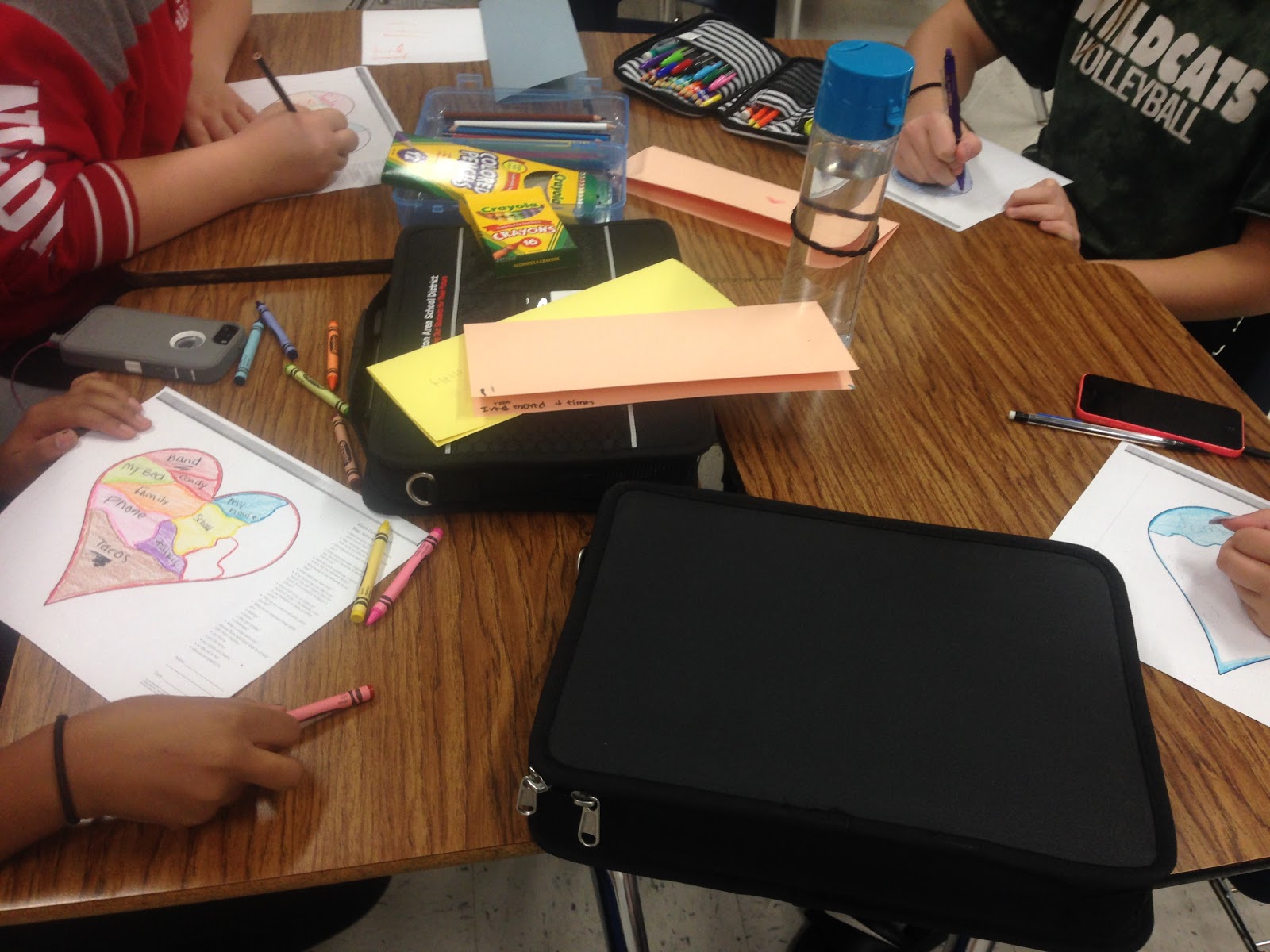
When it was time for them to create their own Heart Maps, I invited my students to write/draw what was close to their hearts. With the exception of one or two students (who simply needed a nudge to get started), they immediately got to work.


Ninth grade students creating Heart Maps
I wasn't sure how well high school students would respond to making Heart Maps. Yet, they seemed to welcome the time to think and write and sketch. Most of my students worked right up until the end of the class hour, and a few of them requested to work on their Heart Maps at home, even though it wasn’t an assignment.


I plan to use Heart Maps as an entry point for students to use in their writing. In addition, if and when students are ready, perhaps they will tell me more about what sketches and words on their Heart Maps signify.

I will keep trying.

***********************************************************************
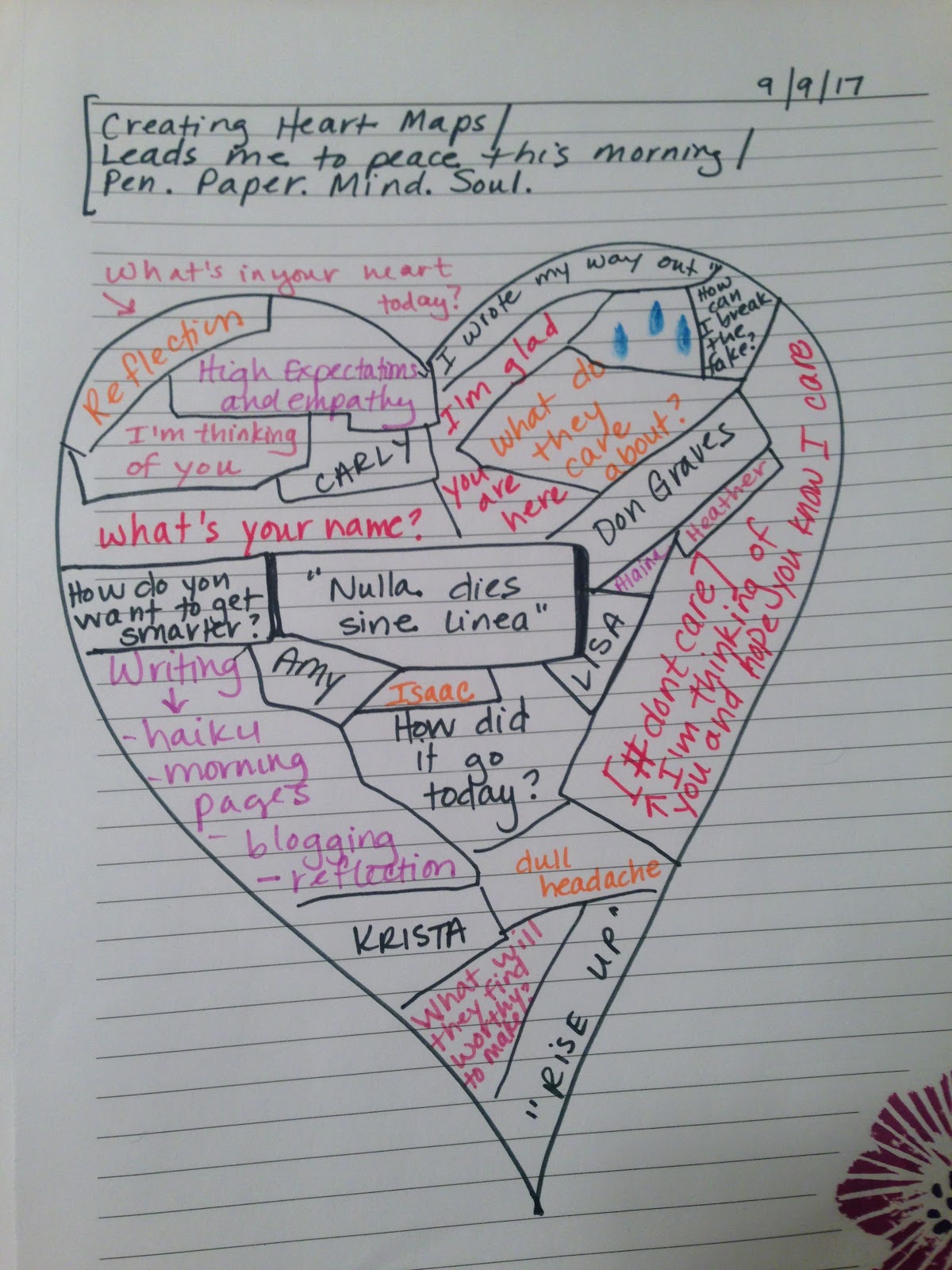
When I woke up this morning, I found myself feeling overwhelmed in thinking about all I need to prepare for the upcoming week. As I wrote today's Morning Pages, I decided to create a Heart Map based on all that is lingering in my heart from my first week with my students.


Trina's Heart Map - September 9th
As soon as I was finished, I realized that Heart Mapping was exactly what I needed today. It soothed my busy mind. If you peeked into my notebooks, you would see Heart Maps scattered throughout my writing. I appreciate the time to reflect, and always provides me with insight about what I am really feeling. It is a simple tool that has helped me understand who I am and the kind of person I strive to be.

Thinking about Heart Maps inspired me to write this Haiku:

Creating Heart Maps/
Leads me to peace this morning/
Pen. Paper. Mind. Soul.

Saturday, September 2, 2017

Know Better, Do Better

Know Better, Do Better

My formal teaching career launched eighteen years ago as a language arts teacher in an urban middle school. Like most first year teachers, I struggled with almost everything - classroom management, developing units, teaching grammar and spelling, and how to assess writing. I quickly realized that having my own class was really not the same as my student teaching. I was a secondary English Education major, but I often found myself lost. I didn’t know how to help my students who refused to read. I didn’t know how to effectively teach young writers. I didn't know what to do when students wouldn't participate. I didn't now how to give fair grades to students. Yet, I pretended that I was just fine - that I knew everything I needed to be an effective teacher. There was no way that I would admit to Mrs. Wiegand, my principal, that I needed help and had a lot more to learn. I wasn’t vulnerable enough with my colleagues to ask for help either. And there was no way that I could reveal to my eighth grade students that I didn’t know something or had to search to find an answer.


I believed that I could never show weakness or appear that I did not know something. I was terrified that someone might think that I wasn’t a good teacher or didn’t belong in the classroom.


Fortunately, I don’t feel that way anymore.

A few years ago I attended a conference called Comprehension X3 in Madison, WI and I heard someone ask author and staff developer Cris Tovani about how she assessed student writing and reading using standards in her grading. Her response was something like, “I’m not there yet. I am still trying to figure that out.” I was blown away at how vulnerable she was in sharing this statement in front of a large group. I even wrote down the question and her response in my notes with an exclamation point. In a breakout session later on, Cris also shared who influenced her thinking and the titles she was reading to learn more about standards based grading. I'm sure it wasn't a big deal to Cris, but it showed me that it was okay to admit when you don't know an answer. By this time I was learning more and more about being an effective teacher (and changing my instructional practices), but I realized that I wasn't sharing this with my students or colleagues.

Recently, one of mantras has been this phrase: know better, do better. I am a completely different teacher than I was eighteen years ago. Now I read more professional resources, attend literacy conferences, and am involved in our Wisconsin State Reading Association. I take the time to reflect in my writing as a teacher and learner. Unlike my first few years of teaching, I am not afraid to ask questions, even if I know it exposes exactly what I do not know. Perhaps, and most importantly, I am a better listener to my students and understand how much they can teach me about their learning.

These are the areas that I am most interested in as a learner right now: 
  • How to teach reading more effectively to high school readers
  • How to give and get better feedback from my students
  • How to plan my instructional units better, including using learning targets better and what author and staff developer Samantha Bennett calls an effective "make"
  • How to empower student voice through writing
Last year a classmate in my daughter’s third grade class made this poster:
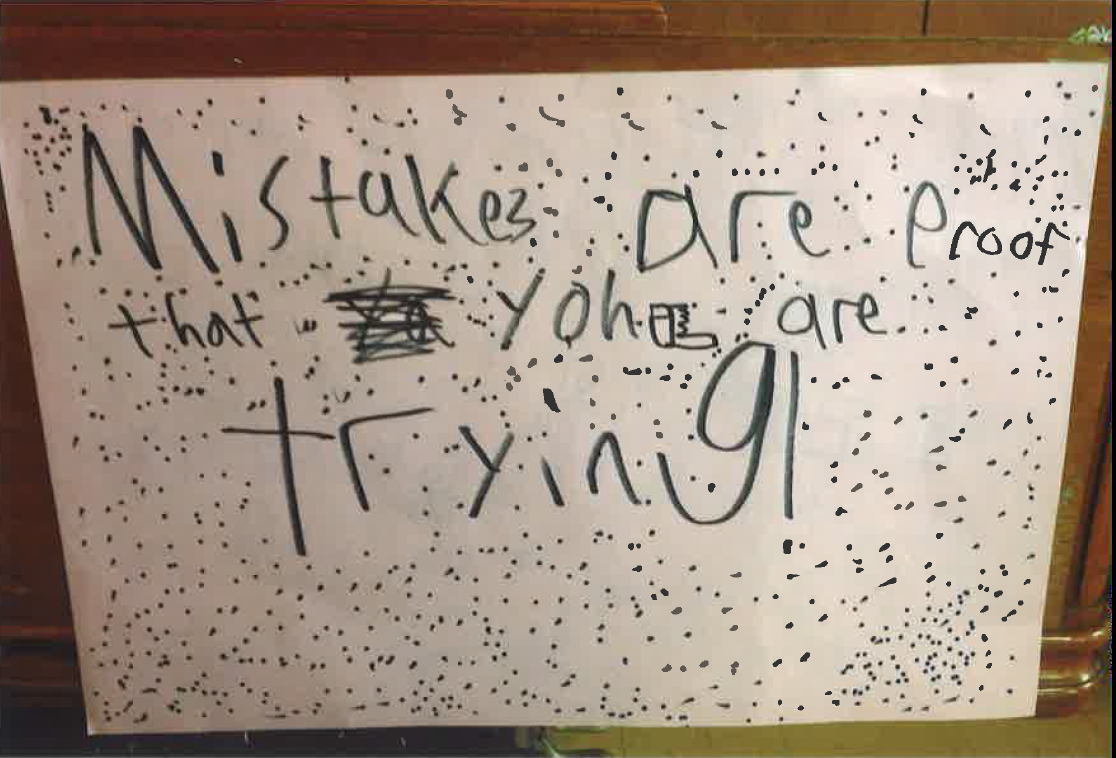
This poster was created by one of my daughter's classmates and proudly displayed in the classroom.
I couldn't love this more. I hope to show my students more of my mistakes this year so they can see that I am learning. I want them to see that sometimes I struggle in what I am doing (and don't know all the answers), but I seek out information when I don't know the answer.

I want to create this kind of culture in my high school classroom, one that values mistakes. One that shows that we are all seeking knowledge. A culture that honors that we are all learners, even the teacher.   

Know better, do better.
Slice of Life Challenge #23: Day 31/31: March Coffee Date

F or the month of March, each day I am writing and posting  a slice of my life , hosted by  Two Writing Teachers .  Slice of Life Challenge ...