Showing posts with label WSRA. Show all posts

Friday, March 1, 2019

March Slice of Life Challenge Day 1: Eleven Things About Me As a Blogger

For the month of March, each day I am writing and posting a slice of my life, hosted by Two Writing Teachers. 


March Slice of Life Challenge Day 1: 
Eleven Things About Me As a Blogger


In celebration of the first day of the 2019 Slice of Life Challenge, I decided to write eleven things about me as a blogger: 
  1. My husband helped me come up with the name Trinarrative for my blog. This is a mash-up of my first name (Trina) and the word narrative. I wanted a name that had to do with writing with a bit of pizzazz. 
  2. I began blogging in the summer of 2017; I am still learning what it means to be a good blogger. Click this link to read my first post. 
  3. It is only my second year participating in the Slice of Life Challenge. After I heard Ralph Fletcher promote the Slice of Life Challenge at the Annual Wisconsin Reading Association Convention and read about it in his professional book Joy Write, I knew that I wanted to try it. 
  4. My big brother, Brian, helped me set up this blog. My friend and colleague, Jeremy, has also helped me figure out blogging. 
  5. I nearly always write my posts out by hand first in my writer's notebook before I type the post in Blogger. 
  6. Last December I challenged myself to write a Haiku-A-Day and publish it on my blog. Among many other bloggers (including my friend Elisabeth), I accomplished this.  
  7. Initially, I began this blog to reflect mainly about teaching and how I was learning as a teacher. To my surprise, I ended up writing a lot about myself as a writer, about my children, and even posting my own poetry.
  8. I am often long-winded as a writer/blogger. I know that most people do not take the time to read anything long (like this post), especially in a digital platform. It is challenging for me to be a concise writer.
  9. Blogging has helped me to be a more reflective person. It has made me notice more and when I look back on my published blog posts, I am almost always grateful that I took the time to write. 
  10. I used to be incredibly self-conscious of every slice I posted on Blogger. I worried that someone would read my writing. I worried that no one would read my writing. Confession: I am still often uncomfortable with this. However, receiving and rereading comments has helped me keep going when I feel self-conscious about my writing (check out the gems writing pals left me in this post).  
  11. Blogging has helped me have an authentic purpose and audience as a writer. I never knew how much I needed this.


Open this link to read my post from last year about my list of eleven things about me as a reader. 

Saturday, March 31, 2018

Slice of Life 2018 Day 31: Joy Writing

"A central goal of school should be to engender a love of writing and reading."
Ralph Fletcher, WSRA Convention 2018 

In the beginning of February I was fortunate to hear Ralph Fletcher speak at the Wisconsin State Reading Association's annual convention. He was inspiring, and I found myself hanging on each word. Nearly two months later, I am still lingering over his insights and on a story he shared about observing his young grandson, Solomon, at play. Young Solomon was in bathtub enamored with a toy - lifting it, flipping it around, sharing it, dropping it, tossing it. Ralph noticed that this kind of play is not so different than what writers do. As writers we often lift, flip, share, drop, arrange writing. What a great analogy! 


If you are familiar with Ralph's Joy Write, you know that he advocates for teachers to create a space for writers to participate in what he calls greenbelt writing. This is when writers have the opportunity to write about they want. No grade. No particular genre. No prescribed topic. No one tries to fix it up. Fletcher says that when we allow students the space for greenbelt writing that teachers see:

  • engagement
  • collaboration
  • playfulness
  • humor
  • pop culture references 
I thought of Ralph's analogy often as I participated in the blogging Slice of Life (SOL) challenge this month, finding that I played more as a writer than I have in a long time. I lifted lines. I shared my work. I dropped ideas I didn't like. I tossed my words around in different sentences and phrases. I tried out different genres of writing. I was inspired by other blog posts and paid more attention to what was around me. Blogging this month was satisfying play. I didn't expect to find as much joy in participating in SOL. 

This past week my tween son and daughter and I were on spring break. We stayed in town, and I tried to limit their screen time whenever I could. To my surprise, whenever I sat down to write this week, my daughter and son joined me. My daughter loves to write, so this didn't surprise me about her, but it shocked me that my son wrote with us. My twelve-year-old son is emphatic about how much he hates writing, especially in school. Yet, this week he spent hours creating intricate comic strips, full of humor and voice. 

From afar, I listened to my children help each other, rehearse dialogue, giggle together, and hide their sketches and words from me. None of this writing was for school or for any special purpose other than my children simply enjoyed it. 

Quickly, I realized that my children were doing exactly the kind writing that Ralph Fletcher is a strong champion of - greenbelt writing. 

Sketch. Write. Play. Repeat.
One of the comics my daughter created
Part of a comic my son created
I was delighted to see my children play in this way. With words. With dialogue. With voice. 

Joy writing. 

Observing my own children play with writing this past week and reflecting on myself as a writer through the SOL challenge makes me wonder more about my own teaching practice. I write with my students. I find mentor texts for students to emulate. I pay attention to what students are reading and writing to guide my instruction. I allow for as much choice as possible. I try to teach writers in manageable chunks. I try to teach instead of just assign. Yet, I nearly always dictate the genre or topic. I don't assess every piece of writing, but I don't provide a lot of time for just play in writing. I am not making any kind of time for greenbelt writing in my classroom. 


Last August I wrote a post about why I write and some lingering questions:

  • How can I help to empower my students to see how they can write their way out?
  • How do I help writers find joy in writing?
As the end of the school year approaches, I find myself still grappling with these same questions, and I find myself with more questions to grapple with: 
  • How can I infuse what I learned about the importance of play in writing with my high school students?
  • Many of my students have not experienced a lot of success in school yet. How can I help them find success with greenbelt writing?
  • How can I teach writers in an engaging way and still follow the curriculum?
One of the last things Ralph Fletcher ended his keynote with was this powerful sentence: "We may cover all of the standards, but if kids hate writing, it's not worth it." 

I still hold onto this sentence, too. It is curiosity that propels me to grow. 

Sunday, February 25, 2018

February Reflections

Since I began blogging last summer, I started paying more attention to what other bloggers wrote about, noticing their content, how their information was shared, and how I could emulate that. Long before I tried blogging I followed blogger and author Ruth Ayres, who I have admired as a writer for some time now. Ruth Ayres has a lovely, exquisite writing voice, and I am always eager to read what she notices and shares. I am especially grateful that she invites other bloggers to celebrate, providing a space to share blog link ups. Sharing my writing continues to be uncomfortable and scary. I continue to find myself in a bit of a frazzle each time I publish my writing in a blog post.

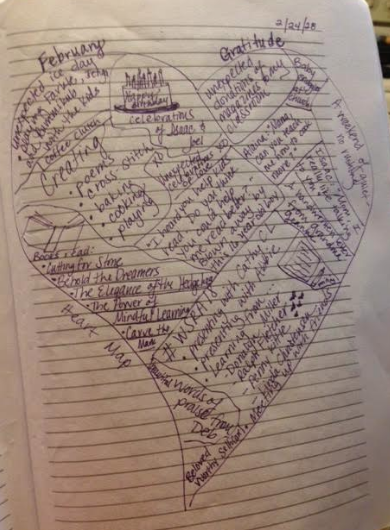
Last month Ruth wrote a post about creating a Heart Map reflecting on her month of January. Of course her post is incredibly inviting and I adored her idea of reflecting on a whole month using a format of a Heart Map. I have been Heart Mapping in my notebook for a while now, but it was almost always based on one idea or after one day. Before Ruth's post, I had not considered Heart Mapping based on the reflection of a whole month (or extended period). As I paged through my journal, I noticed so many things that were worthy of celebrating.This is what February’s Heart Map looked like for me:

February Heart Map (apologies for the poor quality of this image)  

Based on my February Heart Map, there are two things that I wanted to especially celebrate this month:

1. Wisconsin State Reading Association (WSRA) Convention 2018
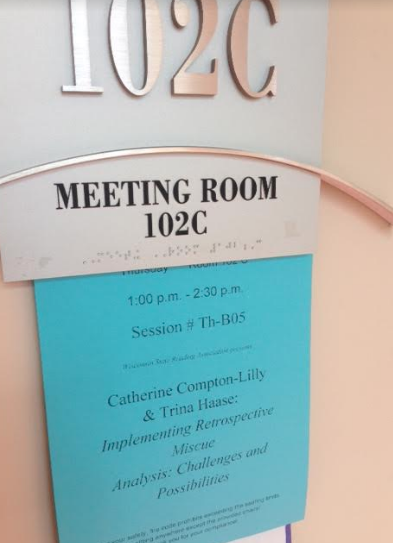
I had the honor to present twice at the WSRA Convention this year. For one of the presentations I was invited to present with Dr. Cathy Compton-Lilly on some of the work that I have been doing with Retrospective Miscue Analysis (RMA) with a few of my high school students. Although I have presented at state and local conferences before, I was really intimidated to lead a presentation with Dr. Compton-Lilly, especially since it was a packed conference room. It was humbling to share what I’ve learned about RMA with over one hundred educators and answer questions.
Our conference room sign 
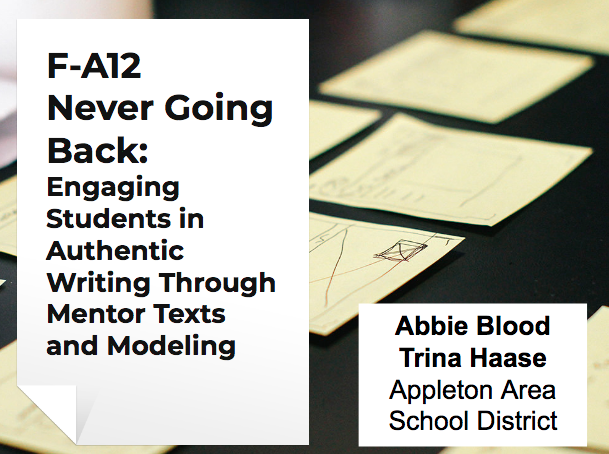
I also presented with my dear friend and brilliant colleague, Abbie Blood. When I was in my role of a secondary district literacy coach in my district I worked with Abbie as often as I could. Abbie and I learned how to use effectively use mentor texts with high school juniors. Our presentation was a celebration of our process, our purpose, the excitement of the difference in quality of our student writers, and how this continues to be a journey of learning for us. Abbie and I presented to a small group of about thirty educators, but they were so engaged and eager to try some of the ideas that Abbie and I presented. After the presentation Abbie shared with me, “I felt so validated as a teacher. I love that there are other people who are interested in this kind of work.”

Our first presentation slide

2. Student Celebration
Recently, I was working on goal setting with my ninth and tenth grade classes using a strategy called WOOP, a strategy used for teaching students to better use self-regulation skills. I invited each student to select one academic goal to work on for Quarter 3. Many of my students set goals such as, “I will complete all of my homework on time in Science” or “I will use my time wisely in math class.” Two weeks later I conferred with each student about his or her goal. One of my sophomores, Nathan (a pseudonym), created a goal about reading. As we were conferring, Nathan quietly said to me, “I heard that you help kids read. Do you think that you could help me read better?” This blew me away. I have never had a student ask me this before. The next week I scheduled a time to meet with him, and we started working on RMA together. I did not expect that using a goal setting strategy and conferring would provide this opening with Nathan.


***************
As my daily writing practice usually includes a Haiku, here is a double Haiku about my February gratitude that I wrote after I completed my Heart Map :

Stuck in negative
Self-talk spooling in my mind,
Yet good surrounds me.

Celebrating joy -
A practice worthy of time
I must continue.

Saturday, September 16, 2017

On Teaching Writers: A Shift in My Perspective

Several years ago I heard Katherine Bomer speak at our Wisconsin State Reading Association (WSRA) Convention. I’m embarrassed to share that at that time I had no idea who Katherine Bomer was, except that she spoke at educational presentations and wrote professional books. When I first heard Katherine speak I was mid-way through my first year as a literacy coach. Along with my colleagues, I was trying to figure out the shifts in the Common Core State Standards and what that looked like in secondary English Language Arts (ELA) classrooms.


In her presentation, Katherine made the claim that everything was an argument. She pointed out that writers always write to convey some sort of message. She challenged us to look for the message writers shared in their poetry and memoirs. We found argument in all of the writing samples, even though it was often implied. I was amazed at the sophistication of writing that Katherine presented from young writers. I remember leaving Katherine's presentation with a headache, thinking about argument and about writing in a way I had never considered before.


Katherine's presentation, especially hearing her statement that everything was an argument, nagged at me for some time. It made me feel uncomfortable. Now I realize that this uncomfortable feeling was one of the best things that happened to me as a teacher and as a literacy coach.

Before I began my position as a literacy coach I taught eighth grade ELA, and I taught students that writing fit into one of three categories: argument/opinion, informational, and narrative. I thought all writing fit neatly into one of those three categories. When we looked at examples of writing from "real life" I was often frustrated that I could not find writing that perfectly fit into argument or narrative or information. I didn't realize then that writers usually blend genres of writing and writing wasn't supposed to neatly fit into one category. I didn't consider that writing (except for essays in school) rarely fit into one category.

Katherine didn't just nudge me to think about the place of argument in writing. She helped me think about myself as a teacher of writers and inspired me to think about how I could teach writers in a more effective way.


Soon after I heard Katherine, I began my own inquiry of how I could be a more effective teacher of writers:
  • I began reading more professional books, especially by teachers who worked more at the elementary and early literacy levels. I read books by Katie Wood Ray and Ralph Fletcher and of course, Katherine Bomer.
  • I immersed myself in books written by professional writers like Anne Lamott and Natalie Goldberg.
  • I started investigating the possibility of using mentor texts and went through the process myself of emulating mentor text with students and teachers.
  • I participated in a writing institute through our local site of National Writing Project.
  • I began writing again, not just as an example for students or as a personal journal. Really writing and living as a writer. Noticing. Playing with ideas.


My perspective changed of what it meant to be a writer. My perspective changed of what it meant to be a teacher of writers.


Now I have students of my own again. Full time. I'm not teaching writers in the same way that I used to. In fact, last week I found myself sharing with my high school seniors the same message that Katherine Bomer shared with me: everything is an argument. I challenged my students to find the author’s argument in essays and poetry.


In an effort to get to know this year’s students better and to continue to establish writing routines, I invited each student to think and record their typical daily schedule. This was an activity that I tried at last summer’s Fox Valley Writing Project’s C3WP’s Advanced Writing Institute. Here is my schedule I shared with my seniors:
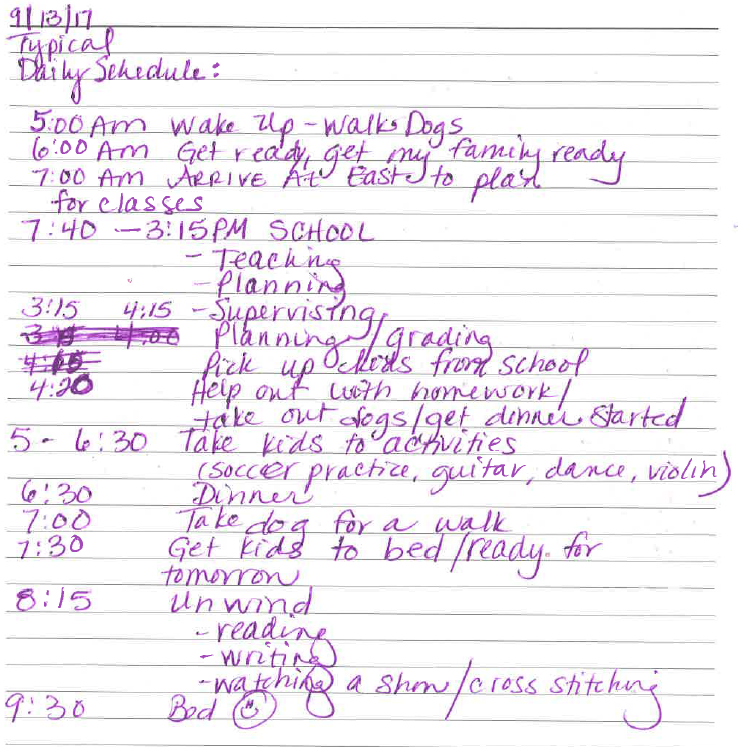

My typical day's schedule 


Next, I invited students to highlight or star areas that stood out to them or what they viewed as important.
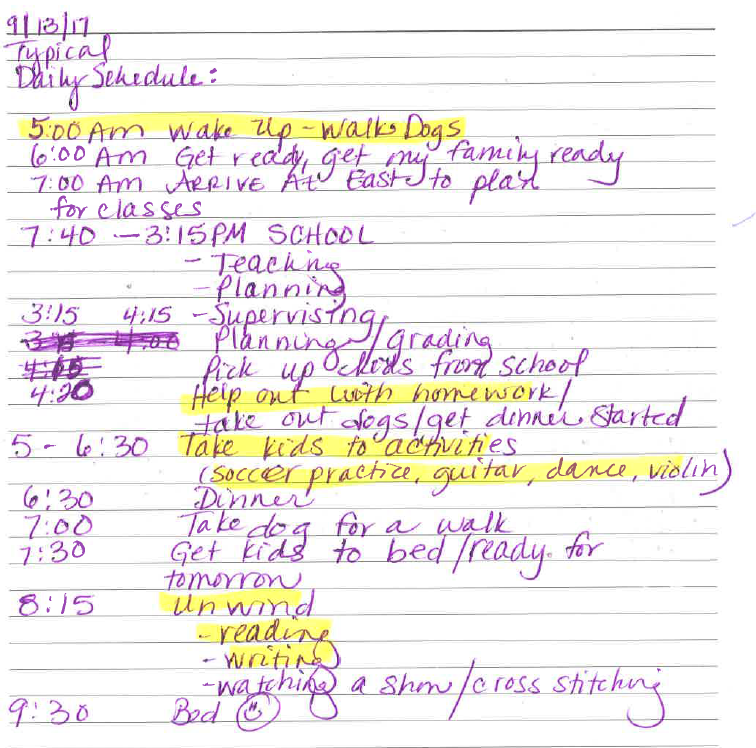
My schedule with highlights 
And then, based on what students highlighted or starred, I invited them to generate a few claims about what their schedules revealed about them. Here are a few claims that I came up with based on my schedule:  
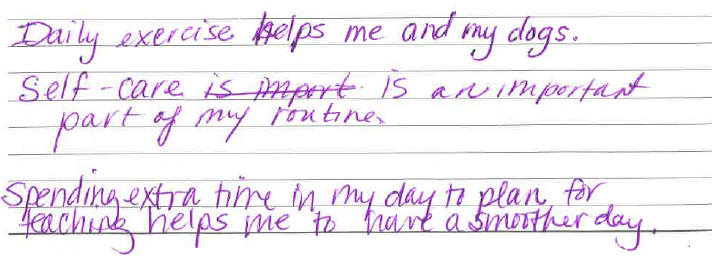
My claims 

Finally, I ended class that day with an invitation for students to select one claim to write about in a Quick Write. I wrote my Quick Write using the document camera in front of my students, emphasizing that Quick Writes are not about perfection or even really good writing. Quick Writes are a starting point for writers.

My Quick Write
As I look back to how I used to teach writing, I realize that I was not really teaching the writer. I was teaching writing to students that would only be helpful to them in a school setting. I used to require my students to write a narrative essay, an informational piece, and an argumentative essay, usually in the form of a mega research paper. I didn't model my own writing very much as a teacher. In fact, I did a lot more assigning than teaching. For the most part, my students didn't care about writing, and I didn't enjoy teaching this way either.


Now I'm working more to invite students to write about topics they are passionate about. I search for ideas to help my students write for real purposes and an authentic audience. I'm writing with my students and sharing my writing more than I ever have before.

I now see my students as teachers who I learn from.

I remain in awe of Katherine Bomer. I had the opportunity to hear her speak again this past February. This time I got to meet her and talk with her. I think she's a gifted writer, passionate speaker, and a genuinely kind and compassionate person. However, I am most grateful of how my initial discomfort from Katherine's words helped me grow as a teacher and as a writer. I cannot wait to learn more from her and other teachers who write. Above all, my approach to teaching writers has changed, as well as my journey as a writer.
Saturday, September 2, 2017

Know Better, Do Better

Know Better, Do Better

My formal teaching career launched eighteen years ago as a language arts teacher in an urban middle school. Like most first year teachers, I struggled with almost everything - classroom management, developing units, teaching grammar and spelling, and how to assess writing. I quickly realized that having my own class was really not the same as my student teaching. I was a secondary English Education major, but I often found myself lost. I didn’t know how to help my students who refused to read. I didn’t know how to effectively teach young writers. I didn't know what to do when students wouldn't participate. I didn't now how to give fair grades to students. Yet, I pretended that I was just fine - that I knew everything I needed to be an effective teacher. There was no way that I would admit to Mrs. Wiegand, my principal, that I needed help and had a lot more to learn. I wasn’t vulnerable enough with my colleagues to ask for help either. And there was no way that I could reveal to my eighth grade students that I didn’t know something or had to search to find an answer.


I believed that I could never show weakness or appear that I did not know something. I was terrified that someone might think that I wasn’t a good teacher or didn’t belong in the classroom.


Fortunately, I don’t feel that way anymore.

A few years ago I attended a conference called Comprehension X3 in Madison, WI and I heard someone ask author and staff developer Cris Tovani about how she assessed student writing and reading using standards in her grading. Her response was something like, “I’m not there yet. I am still trying to figure that out.” I was blown away at how vulnerable she was in sharing this statement in front of a large group. I even wrote down the question and her response in my notes with an exclamation point. In a breakout session later on, Cris also shared who influenced her thinking and the titles she was reading to learn more about standards based grading. I'm sure it wasn't a big deal to Cris, but it showed me that it was okay to admit when you don't know an answer. By this time I was learning more and more about being an effective teacher (and changing my instructional practices), but I realized that I wasn't sharing this with my students or colleagues.

Recently, one of mantras has been this phrase: know better, do better. I am a completely different teacher than I was eighteen years ago. Now I read more professional resources, attend literacy conferences, and am involved in our Wisconsin State Reading Association. I take the time to reflect in my writing as a teacher and learner. Unlike my first few years of teaching, I am not afraid to ask questions, even if I know it exposes exactly what I do not know. Perhaps, and most importantly, I am a better listener to my students and understand how much they can teach me about their learning.

These are the areas that I am most interested in as a learner right now: 
  • How to teach reading more effectively to high school readers
  • How to give and get better feedback from my students
  • How to plan my instructional units better, including using learning targets better and what author and staff developer Samantha Bennett calls an effective "make"
  • How to empower student voice through writing
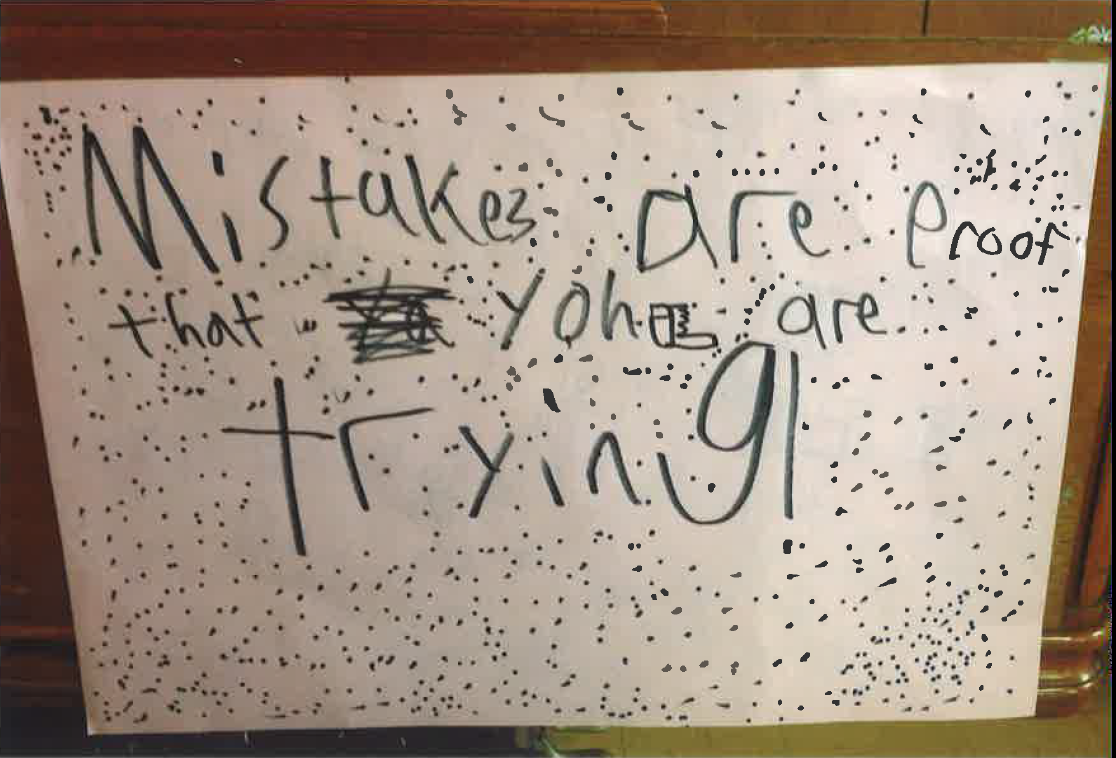
Last year a classmate in my daughter’s third grade class made this poster:
This poster was created by one of my daughter's classmates and proudly displayed in the classroom.
I couldn't love this more. I hope to show my students more of my mistakes this year so they can see that I am learning. I want them to see that sometimes I struggle in what I am doing (and don't know all the answers), but I seek out information when I don't know the answer.

I want to create this kind of culture in my high school classroom, one that values mistakes. One that shows that we are all seeking knowledge. A culture that honors that we are all learners, even the teacher.   

Know better, do better.

Slice of Life Challenge #23: Day 31/31: March Coffee Date

F or the month of March, each day I am writing and posting  a slice of my life , hosted by  Two Writing Teachers .  Slice of Life Challenge ...